make preferable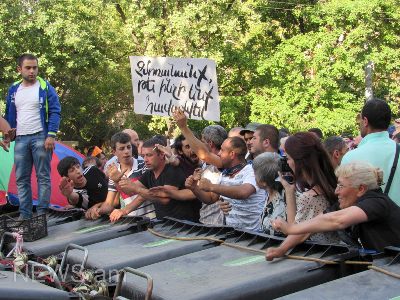
Armenian News – NEWS.am presents the abridged version of the article by Senior Associate of Russia and Eurasia Program Paul Stronski, published on Carnegie Moscow Center website:
“According to the Kremlin narrative, the protests that have rocked Armenia over the past two weeks are the result of the hidden hand of Western intelligence operatives. This narrative is part of a tried and true script of the Western "color revolution," modeled on similar events in Ukraine and Georgia. However, that view profoundly misreads these protests, which arose for domestic, Armenian reasons and are not part of a geopolitical tug-of-war.
With unfriendly neighbors (Turkey and Azerbaijan) on either side, Armenia is dependent on Russia for its economic and military security. These ties, combined with political pressure from Moscow, explain why Armenian President Serzh Sargsyan pivoted from the European Union’s Association Agreement to the Russian-dominated Eurasian Economic Union (EEU) in 2013. However, unlike in Ukraine, there were no mass protests after Sargsyan’s pivot. Armenians recognize the country’s dependence on Moscow. There is no clear split, like in Ukraine, between a pro-Western opposition and pro-Russian government officials. When push-comes-to-shove, Armenian politicians across the spectrum look to Russia because Yerevan has few other options. That dependence on Russia—and the growing perception that Armenia is taken for granted by Moscow and reaps few benefits from EEU membership—has fueled grievances.
What lessons should we draw from these protests?
Armenians are pushing back at the regional turn toward authoritarianism. These protestors are young, and they are not led by well-known opposition leaders. This youth is positive because it shows that civil society is rejuvenating itself, and negative because it lacks leadership. However, democracy by crowd rarely brings stable change. It is unclear whether this movement can develop a platform or a strategy to sustain itself.
The protestors are motivated by socio-economic issues and the desire for social justice—not larger notions of democracy that constitute international human rights advocacy. This desire for economic fairness is not uniquely Armenian but forms part of a regional trend that has been seen in Russia as well.
Armenian authorities are learning from their mistakes. The June 23 police crackdown ended with violence, but only fueled more protests and hardened demonstrators’ demands. The government has behaved better since. It is trying to meet the protestors halfway—a sign that civil society can succeed in pushing the government to address its concerns.
The West is learning from its mistakes too. In 2013, the European Union forced regional leaders to make a definitive choice between Europe and Russia. Its new effort to negotiate an alternate arrangement with Armenia recognizes that each country is unique and that the failed one-policy-suits-all approach was unrealistic.
The United States has been careful not give the impression that it is taking sides in this internal dispute, signaling instead that it is watching and that Armenians should resolve it peacefully through constitutional means. It has not implied that anyone should make zero-sum decisions between Russia and Europe.
While the West is taking an appropriately cautious stance, it is unclear whether Moscow has learned its lesson. Just as it did with former Ukrainian President Viktor Yanukovych in 2014, the Kremlin is likely pressuring Armenian authorities to make that zero-sum decision and to quell the protest decisively. Unfortunately, we all know how well that approach worked out.”