make preferable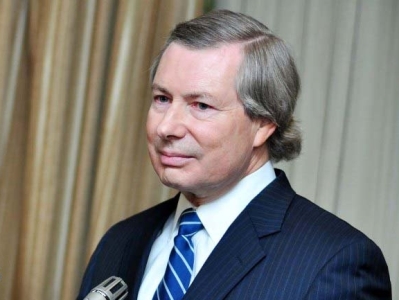
In an interview with Vedomosti, OSCE Minsk Group U.S. Co-Chair James Warlick touched on the OSCE Minsk Group work on normalizing the situation in Nagorno- Karabakh, which started in 1992, as well as on the meeting of the presidents of Armenia and Azerbaijan during this year.
Referring to the actual outcomes of the Minsk process on Nagorno-Karabakh, Warlick said that there’s a big disappointment, particularly in the region itself, since its residents have still been witnessing two-decade-long clashes.
“Armistice, on which we agreed, isn’t fully observed. This raises our concerns. But peaceful settlement is still possible. Last year the presidents of Armenia and Azerbaijan met thrice, and if we also count the successful meeting in Vienna before this, then during the last 12 months overall four meetings took place. They met to discuss these questions. And each of the meetings yielded positive results. Yes, they haven’t yet reached agreement. But I believe that this is possible. And this is exactly because normalization through talks is possible. Washington and Moscow continue to take part in this process. And we are looking for such a way of uniting all these elements and principles that will allow reaching an agreement in the future,” Warlick said.
Responding to the question on how Washington assesses the military situation in the region and whether the continuous skirmishes can turn into a full-fledged war, Warlick said that 2014 turned out to be very dangerous, since the skirmishes resulted in victims among the militants and civilians in both countries.
According to Warlick, January 2015 turned out to be one of the most dangerous months for the last 20 years in terms of regulating the conflict, particularly because of large number of victims. “So, there are reasons to believe that the conflict may expand. This can also happen as a result of miscalculation, as well as any other military clash. For this reason it’s utterly important to work together to find a solution to the conflict through talks and ensure the observance of ceasefire. So the negative point here is that this is a dangerous and bloody conflict, whose escalation may happen any moment. The positive point is that we – the US, are seriously dealing with the search for its peaceful settlement, working with all the parties, urging them to observe the ceasefire and seek to regulate the conflict through talks,” he said.
Touching on Washington’s stance on the recent purchase by Azerbaijan of large weapon consignments in Russia and Israel, Warlick said: “Both sides, Armenia and Azerbaijan, have the right to ensure their security, and in this connection we understand why they need and strive to obtain armament from different suppliers. At the same time, the strengthening of militarization, especially along the line of contact, as well as along the Azerbaijani-Armenian border, raises concerns. We are dealing with this matter. If the ceasefire was violated by sniper rifles and small arms before, we know that now there is larger armament there. And we are concerned about this. We are also concerned about the issue of military balance. We don’t wish the correlation of military force to stimulate one or both parties to use certain privileges. For this reason Armenia must take part in the process of normalization so that the military situation, which is gradually becoming more dangerous, is under control.”
Warlick also referred to Washington’s stance on "whether Armenia should liberate the territories of Azerbaijan", which weren’t included in Karabakh province in the beginning of the conflict, saying that "the occupied territories must be returned to Azerbaijani control in the framework of package settlement". “Here it’s important not to focus on one single element or one principle of normalization. The territories must be returned, but there are other factors as well. For this reason we’re always speaking of package settlement. You can’t take only one aspect and affirm that that is the basis of the normalization.”
According to Warlick, the elements of the normalization should be the security guarantees, which include the installment of peacekeeping forces. “If or when the territories are returned, it will be necessary to install peacekeeping forces to ensure the safety of Nagorno-Karabakh,” he said.
Responding to the question on whether these should be the peacekeeping forces of the OSCE or UN, Warlick said that this matter should be determined by the parties and will be subject to discussion.
Touching on Wahshington’s stance, he said that Washington has no particular preference here. “If the parties agree to the participation and format of the peacekeeping contingent, US are ready to support that choice. But we are not discussing that issue now. We are talking about different versions of guarantee, what they may be, but we haven’t yet reached the point when it’s possible to talk about the formation of peacekeeping forces. I would like to add that OSCE possesses a high-level planning group, whose objective is exactly to develop ways of operations to maintain peace. The group of those military experts already has previously developed versions, which are regularly reviewed. Their work may become a starting point for the international peacekeeping forces,” Warlick said.
Responding to the question on whether the peaceful settlement of Karabakh conflict is possible, considering that the relations between the chief sponsors of Minsk Group (Russia, United States and France) have significantly deteriorated, disagreements between them continually growing, Warlick said that there is tension in relations (between Russia and United States), but this has nothing to do with Karabakh conflict. “This is an area where the views of Moscow and Washington actually coincide. I closely cooperate with my Russian partner. We are working together on a number of aspects of the conflict settlement. And we hope that this will finally result in the normalization of situation in South Caucasus,” he said.