make preferable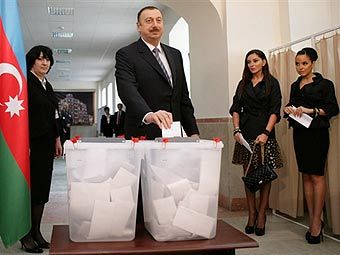
By Ivan Gharibyan
A major decline in voter turnout rather than the easily predictable results marked the November 7 parliamentary elections in Azerbaijan. Showing a blatant disregard for election campaigns over the recent 18 months has - for a major part of the Azerbaijani public - been the only way of protest against the Aliyev clan that has “privatized” the entire country.
Watching Azeri TV channels, with their “masterworks” of obscurantism and provincialism, one gets the impression that the incumbent regime is getting stronger and is not going to leave the political arena in the near future. However, Azeri society, which is becoming better aware of the needs for changes, has launched the mechanism of weakening the seemingly invincible ruling clan. Official figures are evidence thereof. The figures have been reported by the Central Election Commission, which under President Ilham Aliyev’s full control.
Everything seemed fine. March 18, 2009, a nation-side referendum was held. The authorities had proposed a constitutional amendment removing a ban on the election of one and the same person as President of Azerbaijan more than two times.
People were “actively” voting, and concerts were organized in a number of regions before 7:00 p.m., when polling stations were actually closed. The Central Election Commission of Azerbaijan solemnly reported a 71% voter turnout. Of course, almost 90% of the voters “cast their votes for” allowing Ilham Aliyev, the son of the “national leader” Heydar Aliyev, to remain lifelong President. Just a few months later, on December 23, the society delivered a nasty blow on the ruling regime – only 1/3 of the voters took part in the local elections throughout the country.
Many of the Baku officials tried to account for the situation by the traditionally low interest in local elections throughout the post-Soviet area and by the New Year coming.
However, the latest figures reported by the Central Election Commission are a firm indication of an increasing number of Azerbaijani citizens deliberately boycotting the political shows called “elections.” According to official information, the voter turnout hardly exceeded 50%, being as much as 15% lower than in the 2005 parliamentary elections. Moreover, since European observers and representatives of the U.S. Embassy in Azerbaijan reported numerous violations, including ballot-box stuffing at many polling stations, the inevitable conclusion is: most Azerbaijani voters boycotted the election campaign even without any appeals for boycotting it on the part of the formally existing Opposition.
It could not be otherwise. Did Azerbaijani voters have a choice? On the one hand, the corrupt ruling party New Azerbaijan, with splits within its own ranks – a party forcing every school to have a “Heydar Aliyev corner,” devouring the country’s oil resources and sending the sons of poor parents from rural settlements to commit acts of sabotage and die at the border with Armenia. On the other hand, the Opposition formed of the splits of the national fascist Popular Front of Azerbaijan - a concentrate of all the monstrous and barbaric features of Turkic mentality, which disgraced itself in early 1990s. The result is an “indestructible” bloc – the New Azerbaijan Party and “unaffiliated” Parliament members (110 of 125 seats) - the Opposition that remained outside, a voter turnout hardly brought up to 50% and the authorities alienated from and angry with the people. It is as plain as a pikestaff how Ilham Aliyev and his clan are going to vent all their anger: at the top of their voice they are going to cry about “Armenian occupation,” Yerevan as “the capital of western Azerbaijan,” numerous “Azerbaijani genocides” allegedly organized by Armenians and Bolsheviks, etc..
However, the domestic processes in Azerbaijan over the recent 18 months have shown that the idiotic ideas the principal ideologists of the ruling regime have been imposing on the Azerbaijani people are not influencing the public so much as before. The only form of public protest is, for the present, the disregard of elections at various levels – the only form, and for the p