make preferable
Heritage Party of Armenia has issued a statement, which reads as follows:
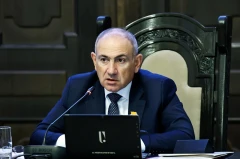
“Heritage Party enshrined the alarming manifestations of the crisis of the single-party system and management system being established in post-revolutionary Armenia in the Resolution of its 12th Congress held on 31 March 2019. The activities of Prime Minister Nikol Pashinyan and his ruling My Step Alliance of the past few months manifest the discrepancy and inconsistency of the actions of the legislative, executive and judicial powers of the Republic of Armenia, and as a result, one can notice that the country’s domestic and foreign policies are stalling.
We believe the months following the revolution were a reasonable period to map and systematize the issues facing the country and develop a strategy for the solution to those issues. Concerned about the course of implementation of the goals of the democratic revolution that took place in Armenia, Heritage Party declares:
(a) different levels of public administration in the Republic of Armenia are adopting decisions, announcing dismissals and appointments that are regularly becoming the reasons for public discord and clashes, and this makes the government either postpone the execution of those decisions or make it impossible.
(b) until this moment, the structure of the Government of the Republic of Armenia remains unclear, but there are serious problems in the sectors of the ministries subject to dissolution, including agriculture, culture and relations with the Diaspora. This attests to the fact that ruling political party’s plan to optimize or improve the structure of the government is not well-developed and does not meet the challenges that currently face the country.
(c) the proclaimed economic revolution is constantly facing internal and external resistance, and the policy for large businessmen and investors is being led with the punitive instruments of the former regime. After the non-violent, velvet revolution, the new Armenia is not specifying new, mutually acceptable rules for doing business that will be equal for all businessmen and will provide the opportunity to draw a line between the current and former working styles. Instead of developing rules and a timetable that will be economically favorable for redemption of taxes and liabilities imposed by the former criminal regime, there are demonstrative punitive measures, the effectiveness of which is clearly dubious and entails varying degrees of lack of public solidarity.
(d) the creation of mechanisms for fulfilling the promises of the slogans declared after the revolution — creating a free and independent Armenia free of monopolies and where the goals of having happy people, a caring society and a powerful country — is being delayed. The reason for this lies in the principles of the policy on personnel led by Prime Minister Nikol Pashinyan, and these principles are sometimes compared to the defective working style of the old regime. At all levels of public administration and even in society, representatives of the ruling party, the team and friends are given advantages, regardless of their degree of professionalism and experience. The developments show that people who have received power, but are not prepared, find themselves entangled in corruption and become a target of the National Security Service rather quickly.
(e) the judiciary is also inactive and is not trustworthy; months have passed, and there have been cases that have drawn the public’s attention, yet none of them has been logically closed. A year has passed since the revolution, yet there are still talks about transitional justice and the demands for the necessary lustration. Instead, there are information ‘wars’, the field is open for ‘armies of fakes’.
Recording the fact that the most anti-revolutionary in new Armenia is the fact that the Prime Minister’s team is not ready to resist the issues on the country’s domestic and foreign policy agendas and that this causes harm to the country, we call on Armenia’s revolutionary government to refuse the “black and white” contraposition, the shortsighted approach to making the public administration system serve for the functioning of the political team, the arbitrary establishment of priorities in the conundrum of problems of the past, and we call on the head of state to refuse to “lay people down on the asphalt”, “break jaws”, the defective working style of initiating or terminating criminal persecutions with his own instructions and refuse to make political calls in public.”