make preferable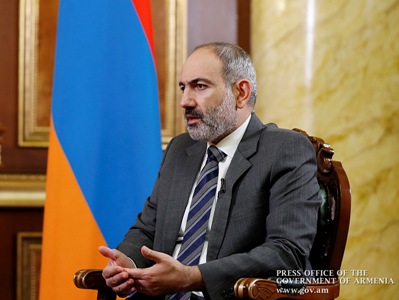
Interview of Reuters with Prime Minister of Armenia Nikol Pashinyan:
Armenian Prime Minister Nikol Pashinyan said on Tuesday he believed that only a change in Turkey’s stance on Nagorno-Karabakh could prompt Azerbaijan to halt military action over the tiny region.
But, in his first interview since a ceasefire deal was agreed in the conflict over Nagorno-Karabakh was agreed in Moscow on Saturday, he gave no indication to Reuters that he saw any sign of Ankara shifting its position.
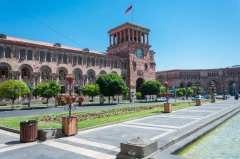
Speaking at his official residence, a huge Soviet-era building in the centre of the Armenian capital Yerevan, Pashinyan accused Turkey of sabotaging the ceasefire and of trying to muscle its way into the wider South Caucasus region to further what he called its expansionist ambitions.
“I’m convinced that for as long as Turkey’s position remains unchanged, Azerbaijan will not stop fighting,” Pashinyan said.
Pashinyan said Turkey had stated publicly, before the ceasefire talks, that it believed Azerbaijan should keep fighting, and that Turkey’s foreign minister had phoned the Azeri foreign minister after the deal. Pashinyan suggested the purpose of the Turkish post-ceasefire call “was really an instruction not to dare under any circumstance to stop fighting”.
“Turkey has come to the South Caucasus to continue the policy it is carrying out in the Mediterranean against Greece and Cyprus, or in Libya, or in Syria, or in Iraq. It is an expansionist policy,” Pashinyan said.
“And the problem is that Armenians in the South Caucasus are the last remaining obstacle on its path to implement that expansionist policy.”
The fighting is the worst since a 1991-94 war over the territory that broke out as the Soviet Union collapsed, and killed about 30,000. It is being closely watched abroad, partly because of its proximity to Azeri energy pipelines to Europe and because of fears that Russia and Turkey could be drawn in.
Pashinyan reiterated accusations - denied by Ankara - that Turkey is carrying on the policies of the Ottoman Empire at the start of the 20th century, something he called a continuation of “the Armenian genocide”.
The Armenian genocide refers to the killing of 1.5 million Armenians under the Ottoman Empire from 1915 to 1923.
If left unchecked in the region, Pashinyan warned that Turkish influence could poison the South Caucasus.
“The whole of the South Caucasus will become Syria and that fire would spread to the north and to the south rapidly,” he said.