make preferable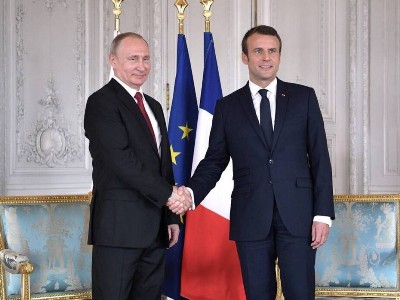
The French president's visit to Russia this week prompted a chorus of cautiously optimistic comments about preventing an invasion of Ukraine, but the United States remains suspiciously reticent about the diplomatic mission, AFP reported.
Ever since Emmanuel Macron met with President Vladimir Putin to try to defuse the crisis, US officials have either remained silent or even skeptical of what European countries are calling progress in preventing war.
US officials have openly expressed doubt that Macron said he received assurances from Putin that there would be no further escalation from Russia.
"Certainly, if there was diplomatic progress, we would welcome that but we will believe it when we see it with our own eyes at the border," White House press secretary Jen Psaki said Tuesday while major US news outlets highlighted statements from the Kremlin that could temper France's upbeat tone.
The day after Macron's trip, as if downplaying any promise Russia might have made to France, the Pentagon said Russia was continuing to build up its forces on the border.
On Thursday, Moscow sent its tanks around Belarus for exercises, prompting an ominous warning from NATO. Russia has also sent six warships across the Bosphorus to conduct routine naval exercises in the Black and neighboring Seas of Azov.
Deputy Secretary of State Wendy Sherman told MSNBC on Thursday that the major military maneuvers launched in Belarus represent, "in our view, an escalation, not a de-escalation."
Washington initially avoided even commenting on Macron's visit, saying it wanted information directly from the French president.
The White House communiqué simply noted that the two leaders spoke of Macron's meetings in Russia as well as Ukraine.
The State Department did not even allude to the Macron visit. It referred more broadly in a statement to "joint efforts by NATO Allies, EU partners, G7 members, and other partners to address Russia's continued military build-up on Ukraine's borders."
Yet the United States is pushing for unprecedented coordination with its allies in this crisis, and French and other European diplomats readily agree: Biden and Macron spoke on the phone three times in eight days.
"The United States welcomes these initiatives because they allow for sending more messages to Moscow, insofar as they are coordinated beforehand and there will be no dissonance among allies," said Pierre Morcos, a French researcher at the Center for Strategic and International Studies in Washington.
Western countries are united in the threat of tough economic sanctions against Russia if it invades Ukraine, although, according to Morcos, "Paris is trying to use the diplomatic route and is putting everything it can into it."
"For now, the United States has cautiously supported Macron's effort at diplomacy. But skepticism runs high, as Washington believes Putin is determined to invade either way," wrote Celia Belin, a French researcher at the US think tank Brookings Institution.
In an article published by Foreign Affairs, Belin writes that unlike the United States and other Western powers, Macron suggested that Russia is 'legitimate' in saying that its security needs should be discussed.
She said it reflected France's desire to reopen dialogue with Russia and retool the European security architecture to rely less on the United States.
But Macron, Belin said, "must tread lightly in order not to appear to be opening a rift among allies at a time when unity is the best deterrence against Russia.