make preferable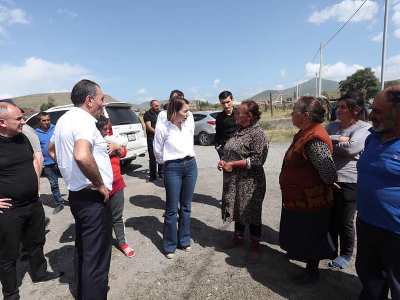
The human rights activist visited the settlements of Vardenis, Kut, Sotk, Norabak, Verin and Nerkin Shorzha, as well as the mountain range of Upper Shorzha. Kristine Grigoryan's familiarization visit began with a meeting with Gegharkunik Governor Karen Sargsyan.
The governor presented to the Defender the problems of the region in the order of priority: the situation on the borders, gasification of the settlements, access to drinking and irrigation water, the existing obstacles for agricultural works, construction works in the region, the implemented and planned programs of subsidizing and other issues, the office of HRD told NEWS.am.
The Advocate noted that he is aware of the existing problems in the region, which exacerbated in 2021. after the Azerbaijani invasion into the sovereign territory of Armenia on May 12-13. Kristin Grigoryan thanked for her cooperation, noting that the HRH staff's familiarization work will continue intensely. "We will be in the communities, we will collect from the residents and get to know the problems, issues that concern the population, and we will be ready to continue discussions together to solve existing problems."
Next, the Defender visited the Gegharkunik Regional Office of the Ministry of Human Rights, where he familiarized himself with the current work of the office, the progress of applications under consideration by the regional office, as well as discussed the work on being done.
Then the Ombudsman and representatives of the Office of the Human Rights Defender visited Vardenis community, where they met with the head of the community Aharon Khachatryan and representatives of the community administration. The challenges, priorities, security and socio-economic problems facing the community were discussed on the spot.
The Human Rights Defender, accompanied by the head of Vardenis community, visited Verin and Nerkin Shorzha settlements and met with residents. People expressed the Defender's concerns mainly about security issues. They noted that they could not use their land, hayfields and pastures because of illegal Azerbaijani settlements. In practice, it has become extremely difficult and in some cases impossible for them to exercise their property rights.
During the meeting with the residents of the border village of Norabak, security issues were raised in the first place.
Residents also prioritized the issue of access to drinking and irrigation water, and noted that due to the reduction in hayfields and pastures, it had become virtually impossible to engage in livestock breeding and the number of livestock had significantly decreased. Problems related to the use of communal arable land by community residents were also raised.
Residents of the border town of Kut brought similar concerns and problems related to security and socio-economic issues to Patpan. Residents of Kut also noted issues of drinking and irrigation water supply, access to intra-village transportation, repair of the village road, and the provision of lighting that need to be resolved as a matter of priority. The issue of compensation for more than 80 cattle belonging to the residents of Kut, who crossed to the territory controlled by the Azerbaijani armed forces last year and haven't been returned, still remains unresolved.
During the monitoring visit to Sotqa, residents expressed to the Defender their concerns about security and employment. In addition, it was noted that due to job cuts at the Sotka gold mine, residents of the settlement faced the risk of being unemployed. Residents reported that after the Azerbaijani invasion, normal life in the settlement has been disrupted, people are unable to provide for their vital needs, they have problems with drinking and irrigation water, and they cannot engage in cattle breeding. farming due to the lack of pastures.
The problems recorded as a result of the familiarization work, as well as the issues raised by the residents, were discussed with representatives of the municipality, who noted that a number of issues are already in the process of being resolved.
In all the communities visited by the protector, residents told of cases where Azerbaijani armed forces were holding community residents in constant fear and causing damage, which was a systematic and uniform action. In particular, the Azerbaijani armed forces burn the grass cuttings of the villagers in large quantities, steal cattle and small cattle, shoot at the inhabitants who do agricultural works near their positions, cultivate the lands belonging to them, shoot at the windows of residential houses. inhabitants' houses with lanterns at night, using flying drones in the airspace of the settlements, day and night.
The described actions prove that these criminal actions of the Azerbaijani armed forces aimed at making life impossible for the communities in their settlements are continuous, coordinated and controlled from one point.
All the recorded problems are under the direct attention of the Human Rights Defender, measures will be taken to solve the problems with full authority.
The Defender will send appropriate letters to the competent agencies, as well as inform the competent international organizations and actors about the criminal actions of the armed forces of Azerbaijan against civilians.