make preferable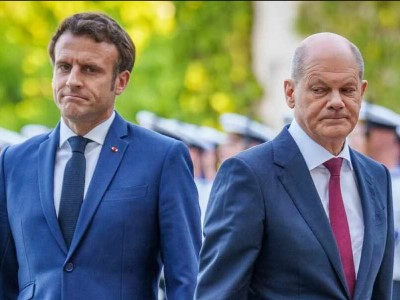
French President Emmanuel Macron and German Chancellor Olaf Scholz met in Paris with smiles and a handshake, but ignored questions about their tense relationship as they headed to the Elysee Palace, Reuters reported.
Scholz flew to the French capital for a hastily scheduled working lunch to find common ground after the French leader postponed a joint cabinet meeting last week over disagreements, including on energy policy and defense.
After the talks, Scholz said the two leaders had a "very good and important conversation" about Europe's energy supplies, rising prices and joint defense projects. "Germany and France stand close together and are tackling challenges together," he said in a tweet.
The Elysee Palace issued a statement saying Macron and Scholz "renewed their commitment to solidarity principles between the two countries and at the European level," and had discussed "ways to move forward on a joint sovereignty agenda."
Moments before Scholz arrived, French government spokesman Olivier Veran downplayed the differences, saying that the French and German leaders have always been able to overcome difficulties that have arisen from time to time. "Today's meeting reflects that this friendship remains alive," Veran said.
Since he came to power in 2017, Macron has instructed French officials never to criticize Germany publicly, French government sources told Reuters, and to resolve disagreements behind closed doors.
But the number of issues on which France and Germany, two of the EU's richest and most influential members, disagree is growing, from the bloc's defense strategy to its response to the energy crisis, relations with China and even fiscal policy.
This has prompted French officials to consider how to become more "assertive" toward Berlin, they said, culminating last week in the unprecedented cancellation of a ritual French-German cabinet meeting that underscored the French president's frustration.
Berlin cited logistical difficulties and downplayed the disagreement.
In the afternoon, German officials said the three hours and 20 minutes the two leaders spent together had been "very constructive and forward-looking conversation," and the pair got along better than the media had suggested.
But it was unclear whether any progress had been made on issues on which the two countries are at odds, including whether to cap gas prices in or subsidize Germany to its industry and households.
The split also affects Europe's plans for next-generation fighter jets, gas pipeline projects through the EU and Germany's plans to allow China to invest in its ports.
Unusually, there was no press conference after the talks.
According to Politico, Macron and Scholz talked one-on-one, but there was no joint press conference in front of cameras, which is usually a routine diplomatic courtesy after bilateral meetings. Berlin had earlier announced that there would be a press appearance. Then the Elysee Palace ruled it out.
After the working lunch ended, officials on both sides, who wished to remain anonymous, said the meeting was a success.
But the canceled press conference speaks volumes about Scholz's dismissive attitude. He went to Paris with a full press corps, and from there was on his way to Athens for another state visit. Refusing to hold a press conference for a visiting leader is a political tactic commonly used for rebuke, as Scholz himself did recently when Hungarian Prime Minister Viktor Orban visited Berlin.
The disagreement over the press conference is just the latest episode in a deepening conflict between the two major powers of the EU.