make preferable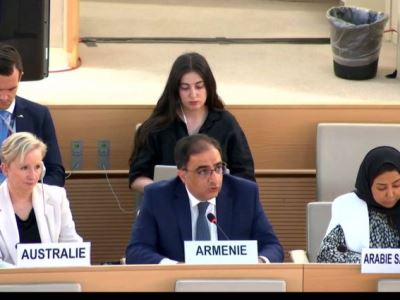
A joint statement on the commemoration of the 75th anniversary of the Convention on the Prevention and Punishment of the Crime of Genocide was read Tuesday at the United Nations Human Rights Council (UNHRC), in Geneva, at the initiative of Armenia.
Forty-one countries covering all regional groups of the United Nations joined the statement.
The statement was read by Ambassador Andranik Hovhannisyan, Permanent Representative of Armenia to the UN Office at Geneva, during the interactive dialogue of the UNHRC with Alice Wairimu Nderitu, the UN Secretary General’s Special Adviser on the Prevention of Genocide.
The joint statement reads as follows:
“I have the honour to deliver this statement on behalf of the cross regional group of 41 States.
“We welcome Special Adviser Nderitu, and reiterate our continuous support to the Office of the Special Advisors of the Secretary-General on the Prevention of Genocide and on the Responsibility to Protect.
“This year marks the seventy-fifth anniversary of the Convention on the Prevention and Punishment of the Crime of Genocide. It was the first human rights treaty adopted by the General Assembly, one day before the Universal Declaration of Human Rights (UDHR). Together, these documents outline a vision of a world where genocide and other mass atrocities are prevented and punished.
“This anniversary offers an opportunity to reaffirm our commitment to this objective and to reflect on best practices and challenges with regard to the Convention’s implementation.
“Genocide never happens suddenly. It is typically preceded by discriminatory practices against a national, ethnic, racial or religious group, and patterns of human rights violations and abuses.
“We vow to mobilise the political will to prevent genocide and other atrocity crimes, notably by using the Secretary-General’s Framework of Analysis for Atrocity Crimes. There is no excuse for the failure to properly address situations where genocide is at risk of occurring.
“We emphasize the role of the UN human rights system, including this Council, the OHCHR, and relevant special procedures, and treaty bodies to collate information on violations of international human rights law and international humanitarian law that may lead to genocide.
Drawing the world’s attention to situations at risk of atrocity crimes requires follow-up actions and coordinated efforts in order truly to make prevention work.”