make preferable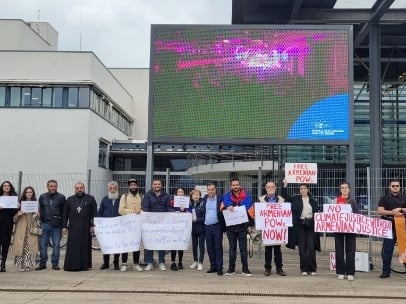
On the initiative of Jonathan Spangenberg, president of the Central Council of German-Armenians, awareness campaigns were held to demand the release of the military and political leadership of Artsakh (Nagorno-Karabakh) and all Armenian prisoners, being illegally held in the Azerbaijani capital of Baku, during the Bonn Climate Change Conference in Bonn, Germany, which was attended by delegates of the countries participating in this United Nations convention.
Armenian News-NEWS.am spoke with Spangenberg about the organized actions and upcoming activities.
The Bonn Climate Change Conference in Germany, featuring delegates of the countries participating in this United Nations convention, essentially sets the agenda for the COP29, to be held in Baku in November. You, your organization, and a number of other organizations initiated active protests last week, rightly highlighting that Azerbaijan is trying to purify its image by hosting COP29. How did these protests go, what were your results, and what will be your next steps?
We organized the actions in a fairly short time frame. We have organized two protests: the first was on Monday, when the meeting started. About 20 participants took part in that protest. The second was on Friday, June 7, with approximately 30 Armenians participating. We were able to speak with quite a large number of delegations there and inform them about Azerbaijan's actions, distributed about 800 leaflets, and we discussed with these delegates the prospect of the latter also voicing our demand. Part of the protests included pictures of Armenian prisoners illegally held in Azerbaijan. Now, our goal is to try to draw attention to our issue, in every possible way, through the protest participants. This implies a need to convey more information to the members of the delegations. There is a segment that is very interested in this issue, and they say that we should be consistent. We should encourage the delegates to raise this issue.
This is not only an Armenian issue; this is a serious human rights issue. It is unacceptable for this [COP29 Conference] to take place in a country that violates human rights.
Our goal was for delegates to be able to raise this issue in their respective countries before COP29 takes place in Azerbaijan.
I don't know to what extent we will succeed, but if we do nothing, then of course nothing will happen.
You also called on the government of Azerbaijan to immediately release the Armenian political prisoners illegally detained in Baku, including philanthropist Ruben Vardanyan. What responses have you received in this regard?
As usual, the Azerbaijani side organizes attacks on social platforms, spreading their false propaganda. I consider it natural and do not assign importance to it. There are also positive reactions.
Before carrying out the protest, we sent a letter to the German MPs about this issue so that they would be more active on this issue. In April, we had meetings in the Bundestag and met with a number of officials, during which time this issue was also discussed. We have received a positive response, but I would not like to elaborate on what steps will be taken in this regard in the near future. We hope that the German deputies will take certain decisive steps. It is important that similar protests are organized in other countries as well.
There are opinions that COP29 is a climate conference, and it should not be mixed with political topics and demands. What do you think about this?
Today, there are two problems in the world that must be solved globally. One is the issue of climate, and the other is the issue of genocide. What happened in Artsakh was a genocidal act, and that genocide is still going on. From a legal point of view, what happened is included in the Convention on the Prevention and Punishment of the Crime of Genocide. The genocidal act continues as long as the leadership of Artsakh is kept in Baku. Both of these acts should receive a global response.
In other words, this is not a political issue. We must show that Azerbaijan has genocidal desires not only for Artsakh, but also for Armenia. Seeing all this, humanity should not remain silent.
The conference should not take place in a country where the leadership of that country is, in fact, conducting genocidal acts. It is tragic that such a conference will take place in that country. The delegates should demand from Aliyev the release of the leadership of Artsakh before the conference. If the international community does not raise this issue in advance, then Baku will definitely succeed, which is unacceptable. There is a very important task before us here; the participation of every Armenian can effect positive change.