make preferable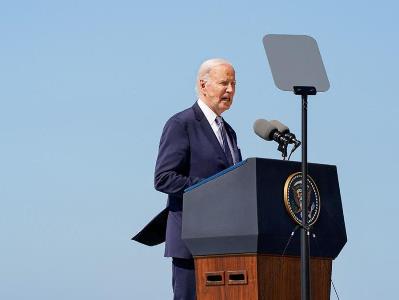
United States President Joe Biden secretly approved changes to the country's nuclear strategy in March. Accordingly, Washington should be ready for the coordinated threat from three countries with nuclear weapons—Russia, China, and North Korea—not only Moscow, The New York Times writes, but does not specify the source of the information.
The paper claims that the Nuclear Employment Guidance is so secret that it is forbidden to make online copies of it, and only a limited number of paper copies exist, the BBC reports.
However, changes in the strategy are briefly mentioned in the last two speeches of not so high-ranking officials of the US administration, writes The New York Times. It is noted that they were specially authorized to pronounce those phrases out loud.
Thus, in June, Pranay Vaddi, a senior director of the national security council, said that the new strategy emphasizes the need for simultaneous deterrence of Russia, China, and North Korea.
Before the end of his presidency (January 20, 2025), Biden is expected to send an unclassified notification to Congress about the change in strategy, and it will be more detailed than what these former or current officials have disclosed, writes The New York Times.
Since the 1940s, the main focus of American nuclear strategy has been threats from the Soviet Union and Russia.
It was the only country with a nuclear arsenal comparable to that of the United States, and the risk that the other nuclear powers would coordinate in a United States confrontation with the USSR was considered low.
But in recent years, China and North Korea have begun to rapidly increase their stockpiles of nuclear weapons. At the same time, they do not want to enter into negotiations on limiting these weapons, and the international nuclear arms control regime has been collapsing in recent years.
There are no reporting mechanisms for the number of warheads these countries have, but the Pentagon estimates that China will have 1,000 nuclear warheads by 2030 and 1,500 by 2035, which is close to the number in the arsenals of the United States and Russia.
Sources told The New York Times that China is likely even ahead of that schedule. According to American estimates, North Korea currently has about 60 nuclear warheads.