make preferable
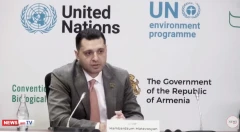
Today, responding to a journalist's question, RA Deputy Foreign Minister Mnatsakanyan Safaryan confirmed the RA's principled position on unblocking regional channels. In his statement, the deputy minister repeatedly emphasized the principles that are considered key for the RA, including sovereignty, territorial integrity, and national jurisdiction, which must be respected in the proposals and decisions under discussion, leaving no room for misunderstanding. This was written by RA Foreign Ministry spokesperson Ani Badalyan on her Facebook page.
She noted, in particular: "The Deputy Minister categorically rejected the term and phenomenon of ‘third-party control’.
Despite this, the issue was distorted by various media outlets and social media users with the aim of spreading false headlines and creating unfounded noise against the backdrop of the talks in Abu Dhabi.
We reiterate that the vision for unblocking channels is based on the aforementioned fundamental principles, and we urge our media partners to refrain from publications and actions that deliberately distort reality, including. We expect this publication to be removed, refuted, and disseminated.
Direct quote from Deputy Minister Safaryan: “This process must be implemented within the framework of the sovereignty, territorial integrity, and jurisdiction of the Republic of Armenia. If it complies with these principles, then yes, it can be implemented.”
This refers to an interview with Deputy Foreign Minister Mhnatsakanyan Safaryan on Radio Liberty.
The following expressions are used in the text published by the newspaper.
Radio Liberty: Is it acceptable for Armenia to delegate the function of unblocking to an international organization?
Safaryan: Yes.
Radio Liberty: “So, a third-party company can, if the parties agree, on the basis of reciprocity, control this road?”
Safaryan: “I repeat, if this is fully in line with the principles we have stated, it can be implemented.”
Radio Liberty: Will this international company exercise control?
Safaryan: I note that this is subject to compliance with the principles.
It should be noted that it is obvious that a sovereign country cannot directly transfer the functions of unblocking communications, and that we are talking about the process of ensuring road safety. Indeed, the deputy minister further emphasizes that the word “control” cannot be used and gives arguments regarding sovereignty and so on. However, it remains unclear what powers, if not control over security, Armenia intends to delegate to someone.