make preferable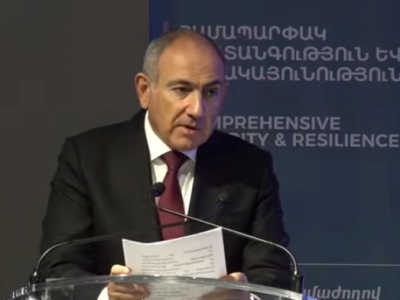
Cohesion is very important from the point of view of the security agenda. But we often forget about an important circumstance that it should be clear and precise about what cohesion is about and what its purpose is. Armenian Prime Minister Nikol Pashinyan stated this in his address at the Comprehensive Security & Resilience International Conference – 2025 that kicked off Monday in Armenia’s capital, Yerevan.
“There may be reactions that it is not clear what it is about, what is there to discuss? In fact, there is a lot to discuss, it is necessary to formulate what we mean by security, whose, and what security we mean, and by what parameters it is expressed.
In my understanding, security is the process of reducing one’s own vulnerabilities. Perhaps one could say that we are striving for invulnerability, but it is clear that there is no such thing as absolute invulnerability; even Achilles and his heel were invulnerable. Our task is to have as few ‘heels’ as possible, or to make those ‘heels’ as protected as possible.
Therefore, has anything changed in our understanding of reducing vulnerabilities in recent years, and if so, what? I must state that considerable circumstances have changed in our understanding of ensuring security and reducing our vulnerabilities.
In the previous period, our understanding was that the primary tools for reducing our vulnerabilities were military-political alliances and the army. But our history has come to prove that this formula did not work in either the first or second point. It did not work in the first part three times. First, the CSTO [i.e. the Collective Security Treaty Organization] stated that [non-CSTO member] Azerbaijan is as much a fraternal state for it as the [CSTO member] Republic of Armenia, and that the CSTO recognizes the territorial integrity of Azerbaijan. We have never encountered this sentence, it seemed to us, or maybe we have found certain formulas to say what is meant by saying ‘territorial integrity of Azerbaijan.’
The fact that by saying ‘territorial integrity of Azerbaijan,’ the CSTO has always meant including Nagorno-Karabakh was reaffirmed by the Russian President on November 18 and December 17, 2020, saying that the territory of Nagorno-Karabakh is part of Azerbaijan from the point of view of international law and has always been considered as such. That is, this primary security concept, the concept of a military-political alliance, did not work in the context of the events taking place around Karabakh.
Although, if we had been attentive, we could have guessed from the very beginning that it would not work because in the context of Armenia becoming a member of the EAEU [i.e. the Eurasian Economic Union], there were very famous, well-known scenes, dialogues that became the cause of great discussions among the public in Armenia, but over time, interest faded again,” the Armenian PM stated.