make preferable
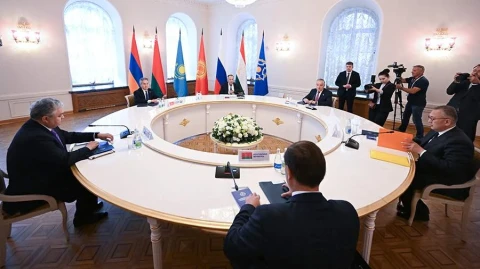
Prime Minister of Armenia Nikol Pashinyan on Friday delivered a speech at the regular meeting of the Commonwealth of Independent States (CIS) Council of Heads of State, being held in Tajikistan’s capital, Dushanbe.
In his speech, Pashinyan stated the following, in particular:
“I am pleased to note that peace has been established between Armenia and Azerbaijan after a long-standing conflict. And the main foundational document of this process was the founding document of the CIS — the 1991 Alma-Ata Declaration.
Following the peace summit held in Washington on August 8 of this year, initiated by [US] President [Donald] Trump, [Azerbaijani] President [Ilham] Aliyev and I adopted a declaration stating that Armenia and Azerbaijan recognize the need to orient toward a brighter future unconnected with the conflict of the past, in line with the UN Charter and the 1991 Alma-Ata Declaration.
In the same [Washington] declaration, we — the leaders of Armenia and Azerbaijan — reaffirmed the importance of opening transport connections between the two countries, to promote peace, stability, and prosperity in the region and our neighborhood, for domestic, bilateral, and international transit, based on respect for each state’s sovereignty, territorial integrity, and jurisdiction. These efforts should include unhindered transport connections between the Republic of Azerbaijan and its Nakhichevan Autonomous Republic through the territory of the Republic of Armenia, for international and domestic transit on a mutually beneficial basis for the Republic of Armenia.
It was also noted that the Republic of Armenia will work with the United States of America and mutually agreed third parties to develop the framework of the ‘Trump Route for International Peace and Prosperity’ — or TRIPP — transport project within the territory of the Republic of Armenia.
The TRIPP project provides Armenia with the opportunity to have railway and other transport links with the CIS member Azerbaijan and other CIS member states. This is a significant change and circumstance that will undoubtedly contribute to strengthening economic ties within the CIS and increasing the organization’s effectiveness. The TRIPP project also opens new export and import opportunities for CIS countries.
Dear colleagues, prior to the Washington summit, and in March of this year, Armenia and Azerbaijan managed to reach an agreement on the draft agreement on peace and the establishment of interstate relations, and concluded the negotiations on the draft with such a positive outcome. This document also makes a reference to the 1991 Alma-Ata Declaration. In this context, the parties confirmed their understanding that the borders between the former Soviet republics have become the international borders of the respective independent states.
Accordingly, Armenia and Azerbaijan recognize and respect each other’s sovereignty, territorial integrity, the inviolability of international borders, and political independence. This means that both countries recognize that the territory of the Republic of Armenia is identical to the territory of the Armenian Soviet Socialist Republic, and the territory of the Republic of Azerbaijan is identical to the territory of the Azerbaijani Soviet Socialist Republic, and that the borders encompassing these territories are inviolable.
The agreement on peace and the establishment of interstate relations between Armenia and Azerbaijan has been initialed at the White House by the foreign ministers of the two countries, in the presence of the US president, the president of Azerbaijan, and myself. I hope and am convinced that we will sign and ratify this agreement in the near future.
It is noteworthy that in 2024, Armenia and Azerbaijan succeeded in signing and ratifying their first-ever bilateral document in history. It is the regulation on the joint activities of the border delimitation commission of the two countries, which was signed by the deputy prime ministers of both countries and ratified both in Armenia and in Azerbaijan, gaining the highest legal force. This regulation also enshrines the foundational document of cooperation — the 1991 Alma-Ata Declaration — as the main principle for interstate border delimitation between the two countries. Based on this principle, approximately a 12-kilometer section of the state border between our countries was delimited in 2024.
Dear colleagues, I am pleased to have the opportunity to inform you of all this, despite the fact that the established peace does not mean that all matters on the Armenia-Azerbaijan agenda have been exhausted. We still have to establish mutual trade, economic, political and cultural ties, and resolve humanitarian issues. And this is not an easy task, considering the long history of enmity.
However, the peace that has been established gives us confidence that these issues will gradually be resolved.
On the occasion of the establishment of peace, I would like to congratulate not only Armenia and Azerbaijan, but also all CIS member states, since I know that all of you greatly wished for this to happen — and it did. Peace is now a reality. And I congratulate all of us on this occasion, and thank my CIS colleagues for their support during this time.”