make preferable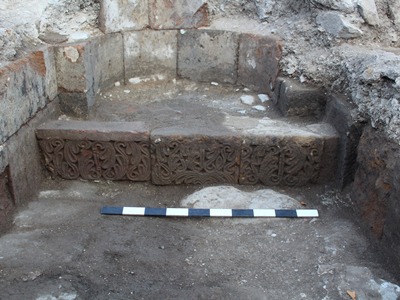
Excavations have discovered an early medieval church at Armenia’s Kecharis Monastery, archaeologist and historian Tigran Aleksanyan informs.
“Until now, we had always seen the area around the Katoghike Church of the Kecharis monastic complex as flat and green, with walkways leading to the church that were renovated several times in the 1950s, 1980s, 2000s. Recently, landscaping work began at the initiative of the Vardanyan and Mkrtchyan families, within the framework of which it was planned to replace the deformed walkways as well.
However, at the very start of the earthwork, tombstones were uncovered, due to which the work was stopped and archaeological studies (archaeologists: H. Badalyan, T. Aleksanyan) began. Their results exceeded all expectations. On the southern and western sides of the Katoghike Church, an extensive medieval cemetery with inscribed and flat tombstones was uncovered. But the greatest result was the discovery, on the western side of Katoghike, of an early medieval church preserved under a thick layer of soil. It is built of tuff, belongs by its design to the type of tetraconch, centrally domed churches, and dates to the 6th-7th centuries.

This is the oldest structure preserved within the territory of the [Kecharis] monastic complex, about which no information had existed until now. Excavations of the church itself have been completed, but the site will remain closed for some time, as work will soon begin also to place the newly discovered church under a temporary protective covering to shield [it] from precipitation and prevent possible collapse.
Thanks to the patrons who funded the extensive excavations, who have generously expressed their readiness to cover the costs of reinforcing the church and improving the entire area as well,” Aleksanyan noted.