make preferable
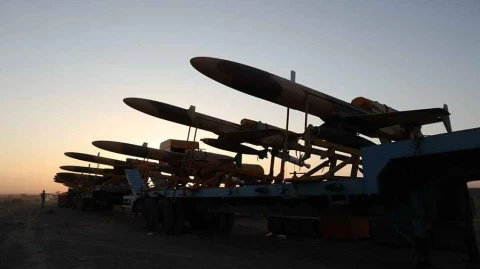
Iran possesses one of the largest missile arsenals in the Middle East — more than 3,000 ballistic missiles, according to a 2022 US Central Command assessment. Over the past decade, the country has also addressed one of their main weaknesses: poor accuracy. This is what concerns the West, and particularly Tehran's regional rival Israel.
Iran's weaponry is conventional in nature. Tehran does not yet possess nuclear weapons and has no intercontinental ballistic missile capable of reaching US territory — nor has it come anywhere near developing one, despite claims by President Donald Trump.
Since Iran's airspace is effectively defenseless due to the absence of modern fighters — only aging MiG-29s and F-14 Tomcats remain in service — and air defense systems were severely degraded by 12 days of strikes in June, the missile arsenal has become the key element of its conventional response to Israeli and US attacks.
Aware of this, during the summer campaign Israel destroyed much of the equipment enabling missile launches: mobile truck-mounted launchers and fixed launch pads.
To prevent such attacks, Iran has in recent years been building so-called "missile cities" — underground bases carved deep into Iranian mountains, sometimes at depths of up to 500 meters, notes military analyst and missile weapons specialist Guillermo Pulido. These facilities, dispersed across the country, can house long-range missiles such as the Shahab-3, as well as the Sejil and Khorramshahr with ranges of up to 2,000 km.
The IRGC Aerospace Force, which controls this arsenal, has previously released footage from the tunnels of such bases as part of its deterrence strategy.
According to Pulido, of approximately 3,000 missiles, "around 2,000 are capable of striking targets in other Middle Eastern countries." Tehran also possesses "a large number of kamikaze drones and cruise missiles." Since Saturday, Iranian missiles have struck targets in Israel, Bahrain, Qatar, the UAE, Kuwait, Jordan and Saudi Arabia — US allies hosting American military bases. According to IRGC-linked agency Tasnim, Iran has already attacked 27 American bases.
Although Tehran has already used several hundred missiles in response to the June airstrikes — and has presumably produced more since — it theoretically still retains "a significant quantity of munitions" with which it can continue striking these countries, American bases, warships, or oil tankers in the Strait of Hormuz, the strategic artery through which a quarter of the world's oil passes.
However, Pulido emphasizes, the effectiveness of Iran's response will depend on whether Israeli and American strikes manage to destroy or seriously damage "the bases from which missiles are launched." If the easily identifiable entrances, exits, and launch apertures of these underground complexes are destroyed, the "missile cities" could become "graves" — missiles unable to launch, trucks unable to leave.
The Israeli army reported Saturday that one of the targets near Tabriz was an "Iranian ballistic missile base" from which "dozens of missiles were planned to be launched at Israel." Satellite images later showed collapsed tunnels at the site.
The strikes on Iran and the subsequent Iranian escalation, intensifying after the confirmed killing of Supreme Leader Ali Khamenei, represent, in Pulido's view, "a perfect example" of a new type of armed conflict — the "salvo war," in which the exchange of missile strikes is the central element. This term, coined by the analyst, describes a conflict "in which the outcome is decided not by territorial capture, but by neutralizing a large number of enemy projectiles capable of destroying your state" — wars fought by "armies based on missiles, not tanks, frigates and aircraft."
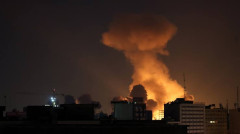
The salvo war continues, demonstrating that Tehran retains at least part of its launch capabilities. Some attacks have been successful from Iran's perspective, as their goal is to raise the cost of the strike campaign for the US and Israel, particularly in human casualties. On Sunday, Washington reported three soldiers killed and five seriously wounded. An Iranian missile that struck a shelter in Beit Shemesh in central Israel killed at least nine people and wounded more than twenty.
Among the targeted "missile cities," the largest is the facility in Khorramabad (Lorestan province), used for storing and launching surface-to-surface and cruise missiles, including the Shahab-3. In East Azerbaijan province lies the Tabriz complex — the country's second largest missile facility, likely the one Israel announced striking on Saturday. The missiles stationed there have long range; some could theoretically reach eastern European countries.
The Tehran area also hosts numerous launch positions and command centers. Other facilities are located in Kermanshah, 525 km from the capital — the Kanesht and Bakhтaran bases near the western border, strategically oriented toward targets in Israel and the Gulf states.
In the central province of Isfahan, according to the Nuclear Threat Initiative (NTI), lies the country's largest missile assembly and production center, whose exact location is not disclosed. Built with North Korean and Chinese assistance in the late 1980s, it produces components, solid and liquid fuel, and assembles missiles including the medium-range Shahab, capable of striking targets in Israel at distances of up to 2,000 km.
"Attacking these bases is not that difficult," Pulido emphasizes. However, until Israeli and American strikes destroy the "launch assets," Iran will retain the ability to "inflict damage." The key factor in this war, notes military analyst Jesús Pérez Triana, will above all be "intelligence" — to locate and destroy these "missile cities."