make preferable
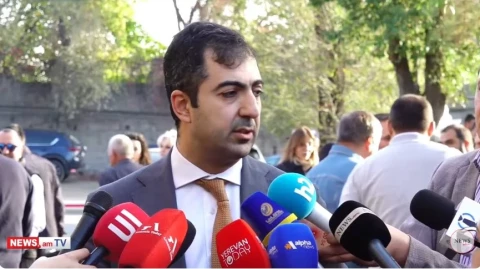
What is behind the U.S. President Donald Trump’s tough anti-Iranian rhetoric and what the consequences of possible increase in tensions between the United States and Iran for Armenia? What should be expected from Trump’s unpredictable Administration. NEWS.am discussed these issues with political analyst Hayk Martirosyan.
What is the reason of the U.S. President Trump’s tough anti-Iranian statements and what are the possible consequences? Do you think the United States will review the nuclear agreement with Iran?
I do not think there will be a review, because the nuclear agreement includes not only the United States and Iran, but also several other countries, which have contributed to it, and I think that the United States government, Trump’s Administration, will not put the prestige of United States at risk. I think that the tensions between the United States and Iran will continue, but I would not expect drastic changes.
Now, why did the relations deteriorated. In some ways it was predictable, because Barack Obama is known for his tense relations with the Israeli leadership, especially for strained personal relations with Benjamin Netanyahu. Thus, many people in Israeli lobby in U.S. did not consider Barack Obama as a friend of Israel. In the meantime, Trump during his election campaign have emphasized his stance as pro-Israeli and contrasted it to that of Obama. Of course, this was done during the campaign. But as we see, Donald Trump is trying to implement almost all of his election promises and in this respect, as he had expressed unconditional support for Israel, he is trying to express his readiness to defend Israeli interests in relations with Iran, which is the fiercest enemy of Israel.
What consequences for Armenia will have the U.S. tough stance on Iran?
First of all, it is not good for anyone, neither Iran, nor the United States, nor, of course, Armenia. Armenia is not a player in the international politics. Unfortunately, Armenia appeared in this situation voluntarily. Thus, if Iran becomes internally unstable and if, God save us, a war starts, Armenia will be affected, and I think that could be tragic because we are the immediate neighbor of Iran and have quite good relations with this country.
The media reports that the U.S. can ease sanctions against Russia demanding in return Moscow’s support in pressure against Iran. In your opinion, is such a development possible and will Moscow accept that?
Everything is possible, but I do not know where the information that Moscow is actively supporting Iran comes from. Iran pursues an independent policy, and the views of Moscow and Tehran differ from each other and, as far as I know, Iranians are trying to maintain their strong position. Russia doesn’t play a dominant role, and Iran does not dependent on Russia. So, I do not rule out that United States and Iran can cooperate in Syria, because President Trump during his campaign stressed the need to collaborate with the Syrian President Bashar al-Assad to destroy the ISIS and other terrorist organizations.
Iran is among major forces in Syria, which particularly fights against Sunni Salafist extremists. In this regard, the pressure on Russia to stop working with Iran is impossible. When it comes to other areas, it is hard to tell as developments happen behind the curtain. Again, I have to say, let us wait and see.
Overall, based on the new U.S. President Trump’s internal and foreign policy actions, what is his real goal, what does he want to do?
He wants to “Make America Great Again.” That is Trump’s motto, which certainly does not belong to him, it was Ronald Reagan’s idea. Trump has a simple idea, to bring the United States back to its former glory. It is hard to say, how exactly Trump wants to return glory to the United States, but in any case, his efforts are directed at the American-centric policy. During his inauguration ceremony, the new U.S. president said “America First”. It had certainly raised some concerns among world leaders, but it is rather difficult to make predictions, because this is one of the most unpredictable and unforeseeable administrations, yet it immediately began to fulfill some of the promises two weeks after the inauguration. It is almost unprecedented. The development of the U.S. foreign policy is very difficult to predict.