make preferable
An explainer for those who have heard the phrase "visa liberalisation" but do not fully understand what it means
In September 2024, Brussels and Yerevan launched a process that has been written about dozens of times over the past year – a "dialogue on visa liberalisation". It sounds promising, and many people took it to mean that visa-free travel to the EU was just around the corner.
In reality, the process is far more complex, and it is precisely this complexity that has generated so much confusion – from inflated expectations ("we'll be travelling to Europe without a visa in a year") to an underestimation of what has already genuinely changed.
We break it down step by step: what already exists, what the process promises, how long it may take, and why nothing is guaranteed automatically.
First – what is already in place: visa facilitation (since 2014)
This is worth spelling out separately because visa facilitation and visa liberalisation are different, and they are often confused.
Since 1 January 2014, the EU–Armenia Visa Facilitation Agreement has been in force. It does not abolish the requirement for a visa. Still, it makes obtaining one cheaper and simpler: reduced fees, simplified documentation requirements for certain categories of applicants, and broader access to multiple-entry Schengen visas.
In parallel, the Readmission Agreement entered into force in 2014. It obliges both parties to take back their own nationals who are present on the other party's territory without a legal basis. The Joint Readmission Committee has held 9 meetings since 2014; the Joint Visa Facilitation Committee has held 7. Both mechanisms are functioning, and their effective operation is one of the preconditions for progress towards visa-free travel. All of this is in force today and will continue to operate regardless of how the liberalisation process develops.
What is visa liberalisation – and how does it differ from facilitation?
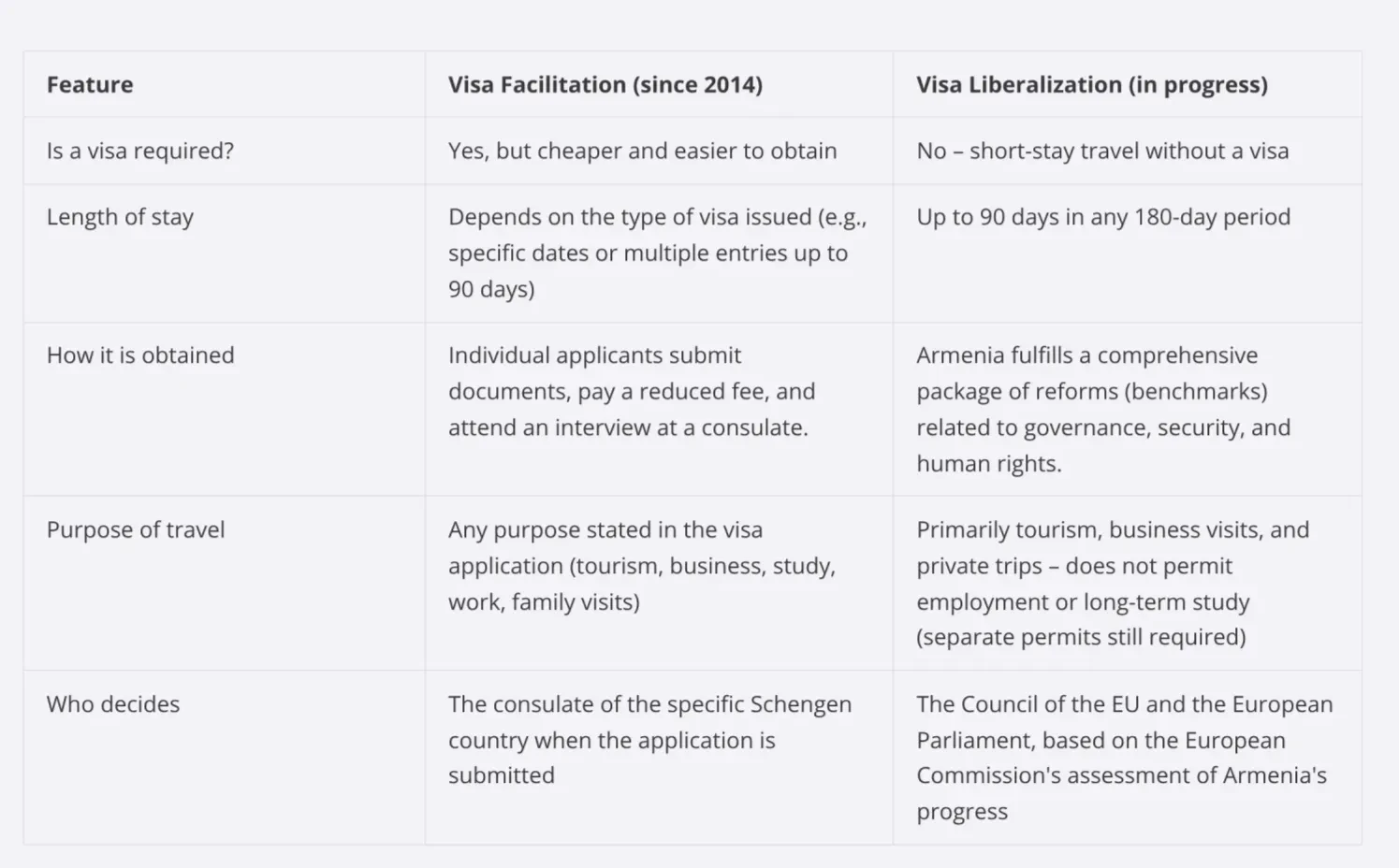
In other words, visa facilitation means the process of obtaining a visa has become easier. Liberalisation means no visa will be required at all. These are fundamentally different in scale, and the transition from one to the other does not happen automatically – it requires specific conditions to be met.
One further important detail that is rarely mentioned: when the visa-free regime eventually comes into force, only holders of biometric passports compliant with ICAO (International Civil Aviation Organisation) standards will be able to benefit from it. Non-biometric passports will not confer the right to visa-free entry – even after the new regime takes effect.
Timeline of the process
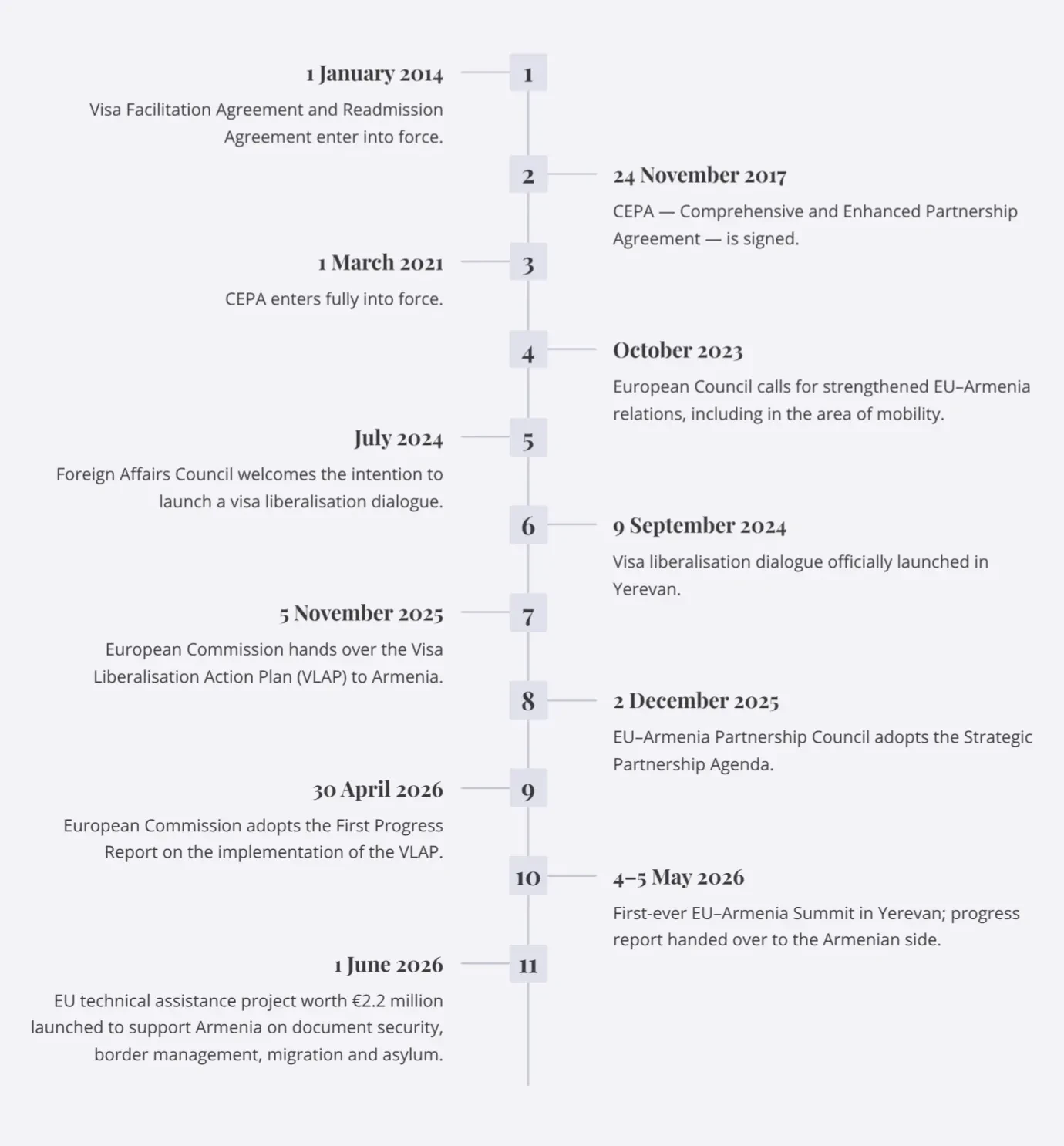
The EU Delegation to Armenia, clarified with NEWS.am that the report published in April and the report handed over at the May Summit are one and the same document. It was adopted by the European Commission on 30 April and officially transmitted to the Armenian authorities on 5 May during the Summit. The next progress report is expected in the second quarter of 2027.
For context: since 2019, Brussels has not launched a visa dialogue with any other country. Armenia is currently the only country with which such a process is actively under way.
What the Visa Liberalisation Action Plan (VLAP) specifically requires of Armenia
The VLAP is not a general declaration – it is a detailed list of concrete requirements divided into four blocks. Benchmarks have a two-tier structure: first, the legislative and institutional framework must be established (first tier); then, it must be demonstrated that the framework functions effectively and sustainably (second tier). Passing the first tier is not sufficient – the European Commission assesses both phases separately.
According to the first progress report, some conditions are already being met. The EU Delegation explained that there is no public breakdown by individual benchmark as yet, but the report records that the first set of requirements on document security (Block 1) and several requirements on migration management (Block 2) are already at an "advanced stage of fulfilment". Armenia is also making progress on the remaining areas – border management, asylum (Block 2), public order (Block 3) and fundamental rights (Block 4). According to the EU Delegation, a more detailed breakdown by individual benchmark is planned for the second progress report.
Block 1 – Document security. The main challenge is that Armenia is not currently issuing biometric passports: the programme was suspended in 2017 due to contractual difficulties. The launch of production of new biometric passports and identity cards is scheduled for late 2026. The VLAP also requires: the creation of a single electronic register of citizens on a "one person – one document" basis; anti-corruption measures in the issuance of documents; and systematic transmission of data to the Interpol database on lost and stolen documents.
Block 2 – Border management, migration and asylum. Armenia is expected to develop an Integrated Border Management (IBM) strategy, ensure inter-agency cooperation, provide access to databases during checks at border crossing points, and cooperate with Frontex. On migration: a modern legal framework and an effective return mechanism. On asylum: compliance with international standards and protection against refoulement.
Block 3 – Public order and security. National strategies against organised crime, trafficking in human beings, terrorism and corruption; a modern anti-money-laundering framework (FATF standards) with an independent financial intelligence unit; expanded cooperation with Europol, Eurojust and the European Public Prosecutor's Office (EPPO).
Block 4 – External relations and fundamental rights. This block covers a broad spectrum of human rights protections and legal integrity. Key requirements include the adoption of a comprehensive anti-discrimination law, the establishment of a dedicated equality body, and the implementation of a national human rights strategy. A crucial focus is also placed on the integrity of legal statuses: Armenia is required to establish fair and transparent conditions for the acquisition of Armenian citizenship. This specific benchmark is designed to address the complex challenges linked to the facilitation of Armenian naturalisation and dual citizenship, while directly mitigating the risk of any potential abuse of the future visa-free regime.
What the statistics show – and why the EU monitors them
Progress is assessed not only based on legislative reforms, but also on the basis of real figures. Asked whether Armenia has a specific set of indicators, the EU Delegation clarified: the indicators are standard – the same ones applied when assessing other Eastern Partnership countries. The Commission monitors the visa refusal rate, the number of Armenian nationals refused entry at the EU's external borders, illegal stay and returns, and the number of asylum applications. The transition to the second tier of benchmarks will only take place after an additional assessment of the "migratory and security impact" of future liberalisation.
Here is what the data from the first progress report and Eurostat show:
Schengen visas issued to Armenian citizens increased from 51,000 in 2019 to 86,300 in 2024 – demand for travel to the EU is growing steadily.
The refusal rate is stable, standing at 13.2% in 2019 and dropping slightly to 12.4% in 2024. Illegal stays are effectively flat: 2,155 cases recorded at the start of the monitoring period (2019), against 2,465 in 2024. Stability amid growing travel numbers is a positive signal.
Asylum applications are showing a significant downward trend: after reaching 5,240 in 2022 and 5,130 in 2024, they dropped significantly to 3,535 in 2025.
The number of multiple-entry visas is growing – a direct consequence of the Visa Facilitation Agreement in operation (increasing from 34.8% in 2019 to 43.5% in 2024).
For comparison: according to the Henley Passport Index, an Armenian passport provides visa-free or simplified access to approximately 80 countries – fewer than those of Georgia (131), Turkey (121), or Azerbaijan (82).
How long does this usually take – three examples
Armenia is the fourth Eastern Partnership country to go through this process. The experience of its predecessors shows that timelines vary considerably:
Moldova: dialogue launched June 2010, visa-free travel – April 2014. Around 4 years.
Georgia: dialogue launched June 2012, visa-free travel – March 2017. Around 5 years.
Ukraine: dialogue launched October 2008, visa-free travel – only June 2017. Almost 9 years.
Formally, the process with Armenia is moving quickly so far: just over a year elapsed between the launch of the dialogue (September 2024) and the handover of the action plan (November 2025). However, the handover of the plan is only the beginning of the substantive phase of the process. There is no official or informal deadline: the EU Delegation in Armenia confirms directly that any projection of timelines is impossible, since the process depends entirely on the pace at which Armenia fulfils the benchmarks.
This is a fundamental point: the process is not automatic. The Council of the EU and the European Parliament take the final decision only after the European Commission has confirmed that all conditions of the plan have been met – not "most" of them, but all, and effectively and sustainably at that.
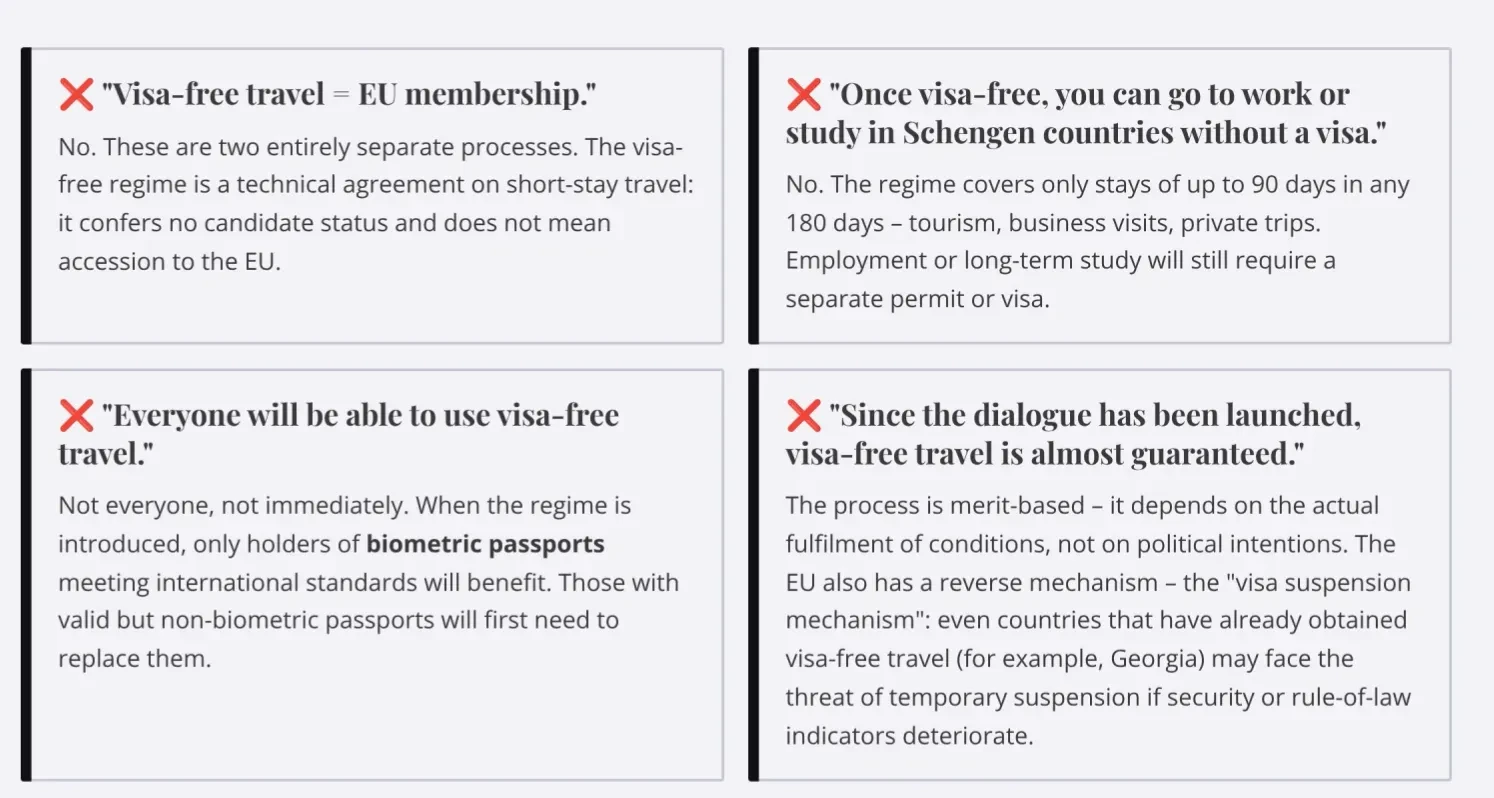
Myths worth debunking
What comes next, and how to follow the process
The process continues without a fixed deadline. The next official milestone is the European Commission's second progress report, expected in the second quarter of 2027. It is intended to provide a more detailed breakdown of each fulfilled benchmark.
Official updates are published by:
The EU Delegation to Armenia: eeas.europa.eu/delegations/armenia
The Ministry of Internal Affairs of the Republic of Armenia, which leads negotiations on the Armenian side
The European Commission's Directorate-General for Migration and Home Affairs (DG HOME)
Diana Arushanyan
This article is based on official EU and Republic of Armenia documents: the Visa Facilitation Agreement (2014), CEPA (2021), the Visa Liberalisation Action Plan (VLAP, November 2025), the European Commission's First Progress Report on the implementation of the VLAP (April 2026), and data from Eurostat and DG HOME. Interview: EU Delegation to Armenia.