make preferable
Past daily of the Republic of Armenia (RA) writes as follows, in particular: The developments in Armenia's domestic political arena surrounding the changing of the Constitution are entering a decisive phase.
Amid authorities' statements that everything will be done to obtain the necessary six votes from the parliamentary opposition, whether through political negotiations or various types of pressure, sharp and unequivocal responses are being heard from the opposition.
In this context, according to opposition circles, the authorities even went the way of "legal" repressions against [opposition Strong Armenia party leader] Samvel Karapetyan, when a decision was made to arrest the figure under house arrest and detain him for a month, which was preceded by searches conducted by investigators of the Investigative Committee on November 5 in his dwelling and the dwelling of the head of the NA [(National Assembly)] [opposition] "Strong Armenia" Faction, [and Samvel Karapetyan’s nephew] Narek Karapetyan.
Karapetyan’s [legal] defender Armen Feroyan has described what is happening as political persecution, and the opposition directly links this step to his willingness to fight against the process of constitutional changes, which is conditioned by external coercion. However, after his arrest, the leader of the Strong Armenia party, Samvel Karapetyan, in a conversation with journalists in court, effectively put an end to this issue, declaring that their political force will not allow the changing of the Constitution, regardless of how long he remains under arrest.
Thus, the leader of the largest opposition force in parliament clearly records that the votes demanded by the authorities will not be given, and any deal is excluded.
The other opposition force in parliament, the “Armenia” Faction, also has an equally tough and uncompromising position. Although the leader of the “Armenia” bloc, the second RA president Robert Kocharyan, who is also under arrest, has not had the opportunity to make a public speech at this phase, the representatives of the faction have clearly emphasized in their statements that any concessions to the authorities on the issue of constitutional changes are excluded.
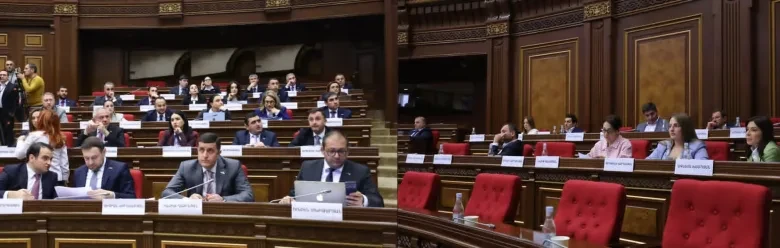
Thus, the two parliamentary opposition factions are closing the topic from the very beginning and not leaving the authorities any opportunity for parliamentary maneuvers or backstage agreements.
In the current situation, when securing the necessary votes for constitutional changes becomes unrealistic, the authorities’ agenda actually remains on the other scenario they have discussed: the matter of going to snap parliamentary elections.