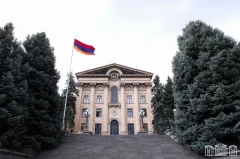
make preferable
The newspaper “Zhoghovurd” writes: “The state paid for the Dilijan and Tsaghkadzor seminars of deputies from ‘Civil Contract’ (with some exceptions, also opposition deputies), and paid quite a large amount — about 630 thousand US dollars. Of course, this is called retraining, consulting, capacity development.
Usually, the United Nations Development Programme (UNDP) in various countries around the world supports state institutions with grants, technical assistance, and expert resources. However, in Armenia there is also a reverse financial flow: under the 2024 financing agreement, the Staff of the National Assembly of the Republic of Armenia undertook to allocate 240,600,000 drams to UNDP.
• The same article also provides a payment schedule:
• 25.12.2025 – 120,300,000 drams
• 25.12.2026 – 120,300,000 drams
The newspaper “Zhoghovurd” tried to find out what exactly the National Assembly of the Republic of Armenia transferred money to the UN for, what results the program is supposed to ensure, and how justified this public expenditure is.
We sent an inquiry to David Arakelyan, Chief of Staff of the National Assembly of the Republic of Armenia, asking him to clarify the legal basis for the financing in the amount of 114 million 765 thousand drams as of April 30, 2026, the content of the program, the services being paid for, the existence of a competitive procedure, as well as the mechanisms for monitoring the use of public funds.
The National Assembly Staff replied that:
“The basis for the financial transfer made by the National Assembly of the Republic of Armenia to the United Nations Development Programme is the financing agreement concluded on 07.05.2024 between the National Assembly Staff and UNDP.”
Incidentally, this agreement was signed on May 7, 2024 and concerns the program “Supporting Enhanced Responsiveness, Efficiency, Transparency and Inclusiveness of the National Assembly of the Republic of Armenia (MAP 2.0/FORSETI).” It is рассчитана на 2024–2027 годы and is being implemented by UNDP with co-financing from the governments of Armenia, Sweden, and Norway. The total budget of the program is about 3.19 million US dollars.
What the National Assembly is buying with this money
According to the response from the National Assembly Staff,
“The purpose of the program is to promote the development of parliamentary capacity through retraining, expert support, and consulting.”
Meanwhile, UNDP’s official description shows that the program has much broader goals than simply organizing trainings. It provides for increasing the institutional capacity of parliament, improving communication with the public, strengthening parliamentary oversight, supporting the legislative process, combating disinformation, and increasing public trust in parliament. Among the program’s performance indicators are, for example, an increase in public awareness by at least 7 percent, training at least half of the deputies and staff members, as well as the development or revision of at least 10 policies with the participation of civil society.
Meanwhile, in reality there is no parliamentary oversight in our country: the National Assembly is under the sole control of ‘Civil Contract’; all positions belong to ‘Civil Contract’, and they make absolutely all the decisions as well.
And why without a tender
The newspaper “Zhoghovurd” also asked whether a competitive procedure had been conducted when allocating such a volume of public funds.
The National Assembly’s response consists of one sentence:
“The sole implementer of the program is UNDP, which is an international supranational structure.”
In fact, no tender or alternative selection mechanism was applied, since the partner is an international organization, which means the money should be given specifically to the UN.
UN CONTRACT — SCREENSHOT IN ENGLISH
Where is the budget justification
The National Assembly Staff replied:
“All justifications for the necessity of the expenditure are presented in the Law ‘On the State Budget of the Republic of Armenia for 2026.’”
“Zhoghovurd” also studied the government decisions ensuring the execution of the budget. They confirm that the list of measures предусмотренных for the Staff of the National Assembly also includes financing for the program implemented with UNDP, and the performance indicators were established by government decision No. 1910-N of December 25, 2025 and its subsequent amendments.
However, the budget documents do not specify which exact service accounts for which amount within the 240.6 million drams, how much money is allocated to consulting, how much to retraining, how much to expert work, or to administrative expenses. The National Assembly also did not provide such a detailed financial breakdown.
How the money is monitored
According to the National Assembly,
“Every quarter, the program submits to the Staff of the National Assembly of the Republic of Armenia a report on all activities carried out, and annually submits an annual report to the Program Annual Council. Meetings of the Program Council were held on 05.05.2025 and 21.04.2026.”
At the meetings of the Program Council, the results of the previous year are discussed and the work for the following year is approved.
The question remains open
At the same time, the effectiveness of the program is in fact not measurable, and there is no oversight either, since ‘Civil Contract’ deputies, using UN and state funds, effectively went to relax in resort towns, where along the way they participated in some trainings or listened to speeches. What this gave the National Assembly and how much institutional capacity increased remains extremely unclear.
The documents show that, from a legal standpoint, cooperation between the National Assembly and UNDP has been formalized, and the program is a multi-year initiative implemented with international co-financing. However, those same documents do not answer the most important question: what measurable result the Armenian taxpayer has received and will receive for 240.6 million drams.
If a private company purchases a service, it is usually shown what work was performed and at what cost. In the case of public funds, such transparency is no less important. But in this case, the public still does not see how the approximately 630 thousand US dollars provided for in the state budget affected the efficiency of parliament’s work, accountability, or the quality of legislation.”
Details are available in today’s issue of the newspaper “Zhoghovurd”.