make preferable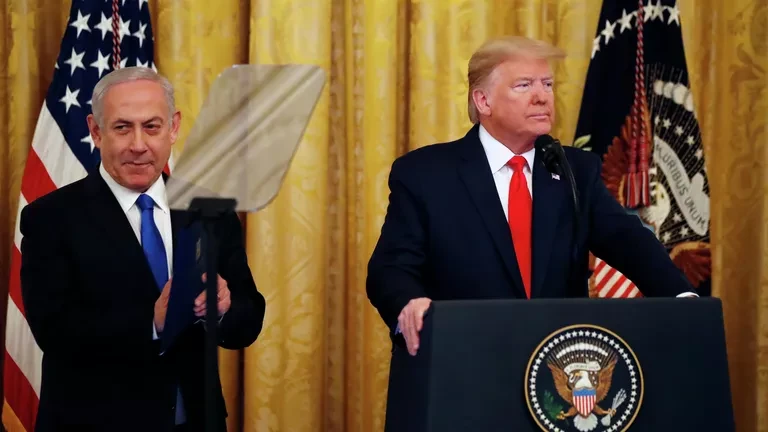
Israeli Prime Minister Benjamin Netanyahu will meet with U.S. President Donald Trump in the Oval Office on Tuesday — their eighth meeting since the president returned to the White House, Axios writes.
As the publication notes, however, this time the Israeli prime minister is arriving in Washington in a weaker position and with less influence than during his previous seven visits.
“On February 28, Trump and Netanyahu entered the war together, and at the time it seemed there were no disagreements between them. But exactly five months later, their interests have diverged more than ever before, while mutual mistrust, irritation, and tension have intensified as both have increasingly begun to doubt each other’s intentions.
Netanyahu’s visit comes just days after Trump halted U.S. strikes on Iran and announced that his representatives were once again trying to reach an agreement with the Iranian regime,” the article states.
As Axios emphasizes, last Friday Netanyahu held hours-long meetings with members of his cabinet on the issue of the war, while having virtually no idea about Trump’s plans and intentions.
“Because of the lack of coordination, Netanyahu and the Israel Defense Forces (IDF) began preparing for the toughest scenario — a resumption of large-scale U.S. military action. Only late Friday evening did Israel learn that Trump had decided not to resume the strikes for now,” the publication writes.
Trump told Axios that he is still considering the possibility of resuming a large-scale military campaign if the negotiations fail. Such a scenario would likely involve a joint U.S.-Israeli military operation similar to Operation Epic Fury, carried out at the beginning of the war.
In the media outlet’s view, the meeting with Netanyahu could be highly significant, as Trump is now assessing his next steps, including possible coordination between the two countries.
However, the Israeli prime minister understands full well that the perception has already taken hold that it was he who dragged Trump into this war. Even if changing that perception is no longer possible, he does not want to once again look like the man pushing the American president toward a new military conflict.
“In the first months of the war, Trump and Netanyahu spoke almost daily, coordinating their actions and exchanging views. However, in recent weeks their phone conversations have become increasingly rare.
According to sources, Netanyahu has increasingly turned to Secretary of State Marco Rubio to find out what Trump is thinking.
Netanyahu even had difficulty securing a slot in Trump’s schedule for the Tuesday meeting. He wanted to come to the White House last week, but was unable to obtain an audience,” the article emphasizes.
After the ceasefire on April 8, the publication notes, Netanyahu’s influence over Trump’s military policy and decisions gradually weakened.
Despite Netanyahu’s skepticism, in mid-June Trump signed a memorandum of understanding with Iran. According to American and Israeli officials, the Israeli prime minister tried to persuade Trump to continue military operations in order to further weaken the Iranian regime’s military potential, but failed to do so.
After the agreement was signed, Netanyahu did not publicly criticize it, hoping that it would collapse on its own. That is exactly what happened a few weeks later.
On Monday, Trump acknowledged that there are certain disagreements between him and Netanyahu on the Iranian issue.
“We have minor disagreements, but overall our positions are very close,” Trump told reporters aboard the presidential plane when asked whether their views on the war align.
The publication also recalls that two weeks ago Netanyahu failed to persuade Trump to abandon the deal to sell F-35 fighter jets to Turkey.
“No one is going to tell me what we should sell and what we should not,” Trump said on Monday, commenting on Netanyahu’s objections. “Turkey has been a wonderful ally to me. Turkey doesn’t like Israel very much... and doesn’t like Bibi very much either.”
According to media reports, Netanyahu was also caught off guard by the nuclear program agreement that the Trump administration signed with Saudi Arabia last week.
According to a Netanyahu adviser, the prime minister was disappointed to learn that the text of the agreement did not include a requirement for Saudi Arabia to normalize relations with Israel — a provision whose inclusion Israel has long insisted on.
“Last week Trump said that implementation of the nuclear agreement would indeed depend on Saudi Arabia joining the Abraham Accords and concluding a peace treaty with Israel. However, on Monday the president admitted that he had not discussed this issue with the Saudi leadership at all.
According to a source directly familiar with the situation, the agreement is expected to be sent to Congress as early as this week, but without any provision on Saudi-Israeli normalization.
At present, Netanyahu is extremely unpopular in Washington — among both Democrats and Trump’s inner circle and supporters of the MAGA movement.
Publicly, Trump continues to claim that his relationship with Netanyahu remains very good. However, in private conversations the president does not hide his irritation with the Israeli leader,” the article says.
In the article author’s view, many senior members of Trump’s inner circle now treat Netanyahu with disdain, believing that he was wrong about virtually everything related to the war.
A number of American officials, including J.D. Vance, accused Netanyahu of making overly optimistic forecasts that later failed to materialize.
“He will come, make his promises, and then we will have to double-check everything carefully,” one senior American official said.
“It has happened more than once that Netanyahu came to a meeting with Trump fearing an unfavorable outcome, and left having achieved what he wanted and convinced Trump to take a position closer to his own.
In three months, Netanyahu will face elections that will be decisive not only for his political future, but also for his personal freedom.
He would like to receive Trump’s public support, but the president has not yet given it. In recent weeks, journalists have asked Trump four times whether he supports Netanyahu, but each time the president has avoided a direct answer.
He called Netanyahu ‘a great wartime prime minister,’ but each time he said it in the past tense.
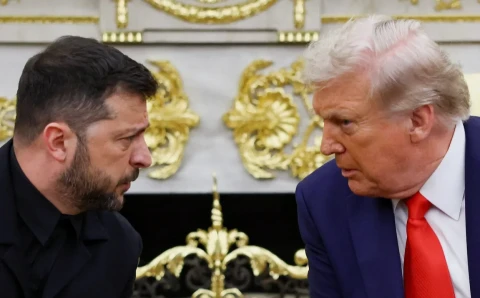
For now, Trump and Netanyahu’s meeting is expected to take place behind closed doors, without the press present. But if the president nevertheless decides to appear before reporters together with the prime minister, Netanyahu could either get a striking joint photo symbolizing successful talks, or find himself in a situation resembling the public dressing-down that Volodymyr Zelensky once received,” the media outlet emphasizes.