make preferable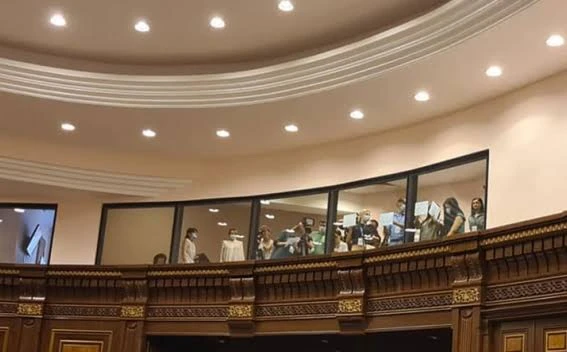
Journalists to Be Banned from Filming the Session Hall from the National Assembly Boxes: New Restrictions — "Zhoghovurd"
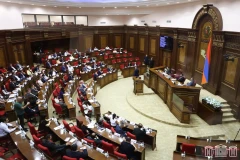
The "Zhoghovurd" daily writes: "Restrictions on journalists' work in the National Assembly are entering a new phase. 'Zhoghovurd' daily has learned that new security rules in effect on the grounds and in the building of parliament's premises have been approved through a decision signed by Deputy Speaker Ruben Rubinyan, who is temporarily performing the duties of Speaker of the National Assembly. A number of the provisions directly concern the professional activity of accredited journalists.
The new rules effectively further restrict the free movement and work of journalists in parliament: accredited journalists may carry out their professional activity only in specially designated areas. To work in other areas, they must obtain permission from the Head of Staff/Secretary General of the National Assembly staff.
In other words, accreditation, which by itself should give a journalist the ability to carry out their professional work in parliament, is no longer sufficient: in some cases a journalist must obtain additional permission from the very institution whose activities they are covering and subjecting to public oversight.
But the restrictions do not end there. In order to ensure journalists' presence at sessions of the National Assembly's standing committees, their list must also be submitted at least two hours before the session begins. And in so-called 'specially monitored zones,' journalists are prohibited from carrying out professional activity altogether.
A question arises: by what criteria will these zones be determined, how proportionate are these restrictions to actual security needs, and won't they turn into an administrative tool for keeping journalists away from MPs and officials?
Even more problematic is the prohibition on video- or photographing State Protective Service employees while they perform their official duties. It is precisely journalists' cameras that, in numerous instances, have documented incidents occurring in parliament — the use of force against opposition figures, obstruction of journalists' work, and other events of public significance. Now, in such situations, a journalist's camera could simply be barred on the grounds that a Protective Service officer is shown performing their duties in the frame.
The rules also stipulate that persons on the grounds of the protected facility are prohibited from 'unnecessarily interfering with or otherwise disrupting the normal work of the National Assembly,' from 'making offensive remarks,' and from failing to comply with the requirements of a Protective Service officer arising from the law and the rules. In other words, the National Assembly staff has also assumed an editorial function, deciding what constitutes an insult and what does not.
However, especially in the case of journalists' work, the formulation 'unnecessary interference' could be problematic if its legal boundary is not clearly defined. A pointed question, walking alongside an MP while asking a question, following up with a repeated question, or demanding an answer should not be classified, at administrative discretion, as behavior disrupting the normal work of parliament. Yet it is noticeable that this is exactly what is likely to happen.
Another important provision concerns appearance. Visitors to the National Assembly are required to have 'appropriate appearance,' and entry is prohibited not only in sportswear or work clothing, but also in 'inappropriate, non-representative attire.' It is at least unclear from the rules who will decide, and by what criteria, whether clothing is 'representative' or not. Such evaluative formulations always carry the risk of arbitrary application.
At the same time, the rules are fairly clear when it comes to privileges. The President of the Republic, the Prime Minister, the Speaker of the National Assembly, the Catholicos of All Armenians, as well as a number of senior officials and their accompanying persons, have the right to enter and exit through the Baghramyan and Demirchyan Street checkpoints without inspection. The vehicles of the President, the Prime Minister, and the Speaker of the National Assembly also pass without inspection.
For journalists, meanwhile, a separate time period has even been established for being present in parliament — from 08:00 to 19:00. If a National Assembly session continues, they may remain until it ends.
All of this is presented as a security regulation, but security cannot become a universal justification for restricting journalistic activity through administrative permissions, special zones, and vague formulations.
The National Assembly is not an ordinary administrative building. It is one of the key platforms for political debate, public oversight, and accountability, and journalists in parliament are not simply 'visitors.' They are there to convey information to the public, to direct questions to MPs and officials, and to document processes that citizens cannot physically witness themselves.
Therefore, the issue is not merely which corridor of the National Assembly a journalist may stand in or where they may turn on their camera. The issue is much more fundamental: is parliament, under the guise of security, once again increasing the physical and administrative barrier between journalists and representatives of authority?
If an accredited journalist is only permitted to work in pre-designated areas, needs the Secretary General's permission to go elsewhere, is entirely barred from professional work in certain areas, and is restricted from video-recording the actions of Protective Service officers, then this is not merely about 'security rules.' This is about a substantial narrowing of the possibilities for journalistic work in parliament.
And here the authorities must answer a simple question: who is the National Assembly protecting itself from — real security threats, or journalists' cameras and uncomfortable questions?"
Details in today's issue of the "Zhoghovurd" daily.