make preferable
It will soon mark one year since representatives of the International Committee of the Red Cross (ICRC) last visited the Armenian prisoners held in Baku. During the intervening months, the ICRC’s efforts to gain renewed access to them have yielded no results.
Similarly, the initiative by Ruben Vardanyan’s wife, Veronika Zonabend, to organize an international humanitarian visit of female human rights defenders to Baku has also failed to materialize. As Ms. Zonabend noted in her recent statement, she has received no official response from the Azerbaijani side — aside from threats in the media — while her written letters to the Government of the Republic of Armenia have likewise gone unanswered.
Seeing that the humanitarian visit was not taking place, on October 1, Artak Beglaryan, president of the Artsakh Union, handed over 1,254 letters addressed to the Armenian prisoners in Baku — collected from various countries around the world at Ms. Zonabend’s appeal — to the Armenian government, requesting assistance in delivering them to their addressees.
Last week, it was revealed that Secretary of the Security Council Alen Simonyan is preparing to travel to Azerbaijan. He also noted that “in Dublin, we discussed the issue of prisoners, as well as the agenda for future meetings,” though he did not specify whether the issue of prisoners would be on the agenda of this upcoming visit.
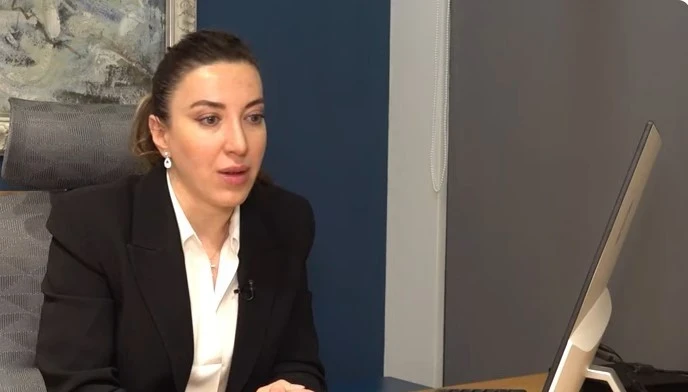
NEWS.am has sent an inquiry on the matter to the Office of the Secretary of the Security Council. In the meantime, we spoke with Siranush Sahakyan, human rights defender and representative of the interests of Armenian prisoners of war and detainees before the European Court of Human Rights (ECtHR).
Ms. Sahakyan, let’s start with the latest news. Last week, Secretary of the Security Council Alen Simonyan announced that a reciprocal visit to Azerbaijan is planned for December. He noted that the visit is scheduled for “Azerbaijan, not the city of Baku,” and did not clarify whether the issue of prisoners would be on the agenda. Does this not represent a good opportunity to raise humanitarian issues, and perhaps also deliver the letters addressed to the Armenian prisoners, given that Armenia's postal services do not operate deliveries to Azerbaijan?
I believe that the issue of Armenian prisoners held in Baku must be one of the top priorities on the agenda of the Secretary of the Security Council of their country of citizenship. Perhaps it is already included — I cannot say, as I cannot imagine it being left off, given the authorities’ repeated assertions that the issue remains a daily priority. This is especially true considering that ICRC representatives were last able to visit the Armenian prisoners nearly a year ago, and since then, there has been no independent information regarding the true condition of the prisoners.
As for the letters, yes, I believe that within the framework of this visit, if they cannot be handed over directly to the prisoners — which would, of course, be preferable — their transfer can at least be arranged through Azerbaijani counterparts. This is a purely humanitarian issue.
Ms. Sahakyan, it appears that the humanitarian initiative by Ruben Vardanyan’s wife, Ms. Zonabend, did not materialize, either, as her recent statement revealed she received no official response to her appeals from the Azerbaijani side, apart from threats in the media, while the Armenian government has failed to respond to both her and your written inquiries. Incidentally, regarding those written inquiries, have there been any responses?
I must note that we have not received any written response, even though the deadlines prescribed by law expired long ago. Frankly, this approach does not align with the authorities’ public assurances that they are doing everything possible for the prisoners. I must state with regret that this is also demonstrative of their attitude toward the prisoners' families.
Ms. Sahakyan, a certain shift regarding the prisoner issue was also recently observed in the statements of Minister of Foreign Affairs Ararat Mirzoyan. Speaking in the National Assembly last week, he stated that “making the issue of prisoners a precondition will distance us from peace,” essentially indicating that only after the signing of a peace treaty will “other issues become easier to resolve.” How would you comment on this? Does this mean that as long as the peace agreement, whose future remains quite vague, is not signed, humanitarian issues cannot be resolved?
From the perspective of international law and international relations, resolving humanitarian issues is paramount because we are dealing with human lives. Therefore, for me, as a human rights defender, this approach is unacceptable. Lasting peace requires the restoration of trust, and the release of prisoners and the resolution of other humanitarian issues are precisely the concrete steps through which the parties can gradually rebuild and strengthen that trust.
International experience also shows that even during active military hostilities, parties can reach agreements on the return of prisoners. In May 2025, while fighting was still ongoing, Russia and Ukraine fulfilled an agreement reached in Istanbul: within three days, each side released a thousand people. Similarly, in Yemen, when the prospects for a political settlement of the conflict were still uncertain, the parties, with the support of the United Nations and the ICRC, reached an agreement that resulted in the release of 869 people in just three days in April 2023.
We also have our own experience. Between 1992 and 1999, the ICRC facilitated the repatriation of 365 individuals detained in connection with the Karabakh conflict and delivered approximately 30,000 messages between relatives separated by the conflict.