make preferable
Interview of the Armenian Ambassador to the Holy See Mikayel Minasyan with the Armenian News – NEWS.am information-analytic agency:
Mr Ambassador, you are the first diplomat who holds the office of the Armenian Ambassador to the Holy See non-concurrently. What are the main peculiarities of your working activity and the key dimensions in the activity of the diplomatic mission?
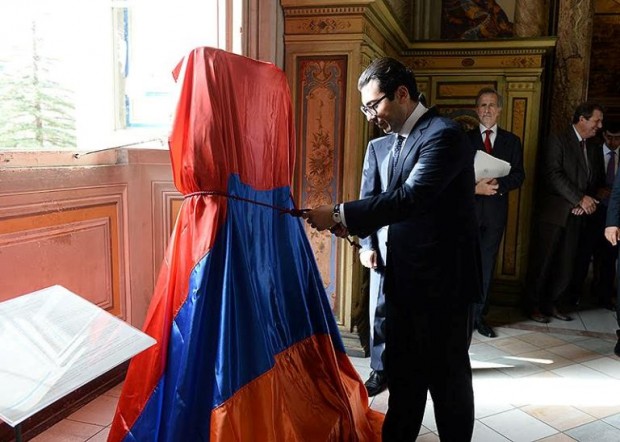
When I arrived in Rome and extended my credentials, I noticed not only pleasure, but also certain surprise in connection with Armenia’s late establishment of its permanent representation in the Holy See. The Catholic Church acknowledges the Armenians’ supremacy as the first official Christian nation. This does credit to us, but this is also a mission which obliges. And it is with this understanding that we present ourselves in the very heart of the Catholic church. Our realities have much in common; there are many common challenges, for instance, the issues of Christians in the Middle East, respect to the human rights and the overall preservation of Christian values. We also actively cooperate on the international platform for the sake of greater justice in the world.
In this context we’d like to ascertain what makes the activity of your mission different from that of other diplomatic missions?
Each reality has its own peculiarities. The work with the Holy See first of all supposes communication with a diverse world, which is somewhat universal. This is a world which is made of the representatives of different nationalities, mentalities and cultures. Occupying a small territory, the Holy See represents a whole world, which makes the daily communication interesting, promotes contacts and opens new prospects for work. Working in such a climate requires the ability to be more open.

In April, Pope Francis served a Holy Mass in memory of the Armenian Genocide victims at St. Peter’s Basillica of Vatican. During the liturgy, he stated that it was the first Genocide of the 20th century. All of us saw the liturgy and heard the message of the Pope, but few know what preparatory activities were carried out in that direction, specifically on behalf of the Embassy. Could you please tell about this?
The liturgy held on April 12 became a real event, which can be called a historical one. If we analyze it, we’ll notice that the most direct and public use of the term “genocide” by Pope Francis had an actually important significance in terms of the further developments even if this was not the first time the Pontific had characterized the Armenian Genocide that way. Specifically, courageous Pope John Paul II paid tribute to the memory of the victims during his historic visit to Armenia.
I also attached importance to the part of the Mass during which Saint Gregory of Narek was declared a Doctor of the Universal Church, which is the highest moral, theological and cultural acknowledgement of the Catholic church. This aspect of the Mass, which was openly supported by the Pope, has a symbolic and unique significance, does credit to the Armenian nation and returns its cultural grandeur, which we sometimes undervalue.
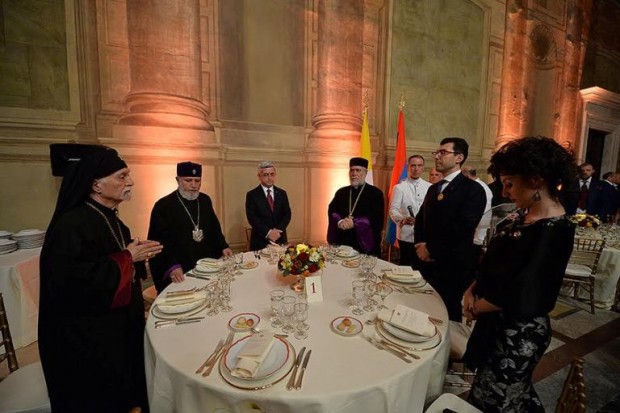
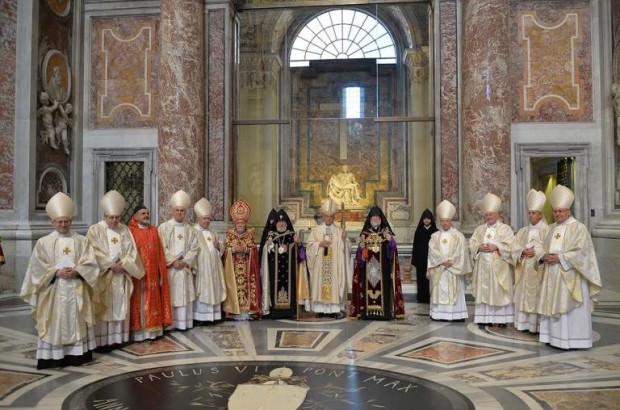
Another proof of the great respect toward our spiritual and cultural values is the ceremony which was held in Naples, during which the relics of St. Gregory the Illuminator again found their rightful place in a Naples church with the same name. All this happened in the presence of high-rank guests. During this ceremony one could already feel the ecumenical spirit, which would make the following 48 hours and specifically the next day different. On that day, the Catholicos of All Armenians, Catholicos of the Holy See of Cilicia, Armenian Catholicos-Patriarch of the Holy See of Cilicia along with the Pope solemnly entered St. Peter’s Basillica, where the President of Armenia and Grand Master of Sovereign Military Order of Malta were present. Apparently, all this required enormous efforts from all the sides. When the diplomatic work is a success, it’s pleasant to talk about the results.
And what work is carried out on deepening the ties between the Apostolic and Catholic churches?
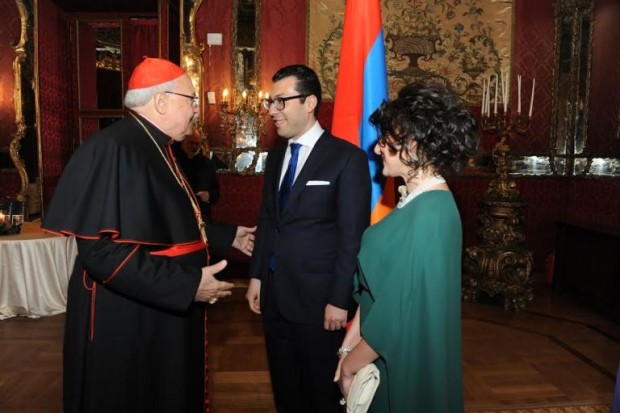
The relations between our churches are merely exceptional. Despite their difference, during my daily work I notice their mutual understanding. Specific measures are taken to assess the similarities and jointly resist the challenges. This is a cooperation which is built thanks to meetings, visits, exchange of documents and experience. Our Embassy is proud of the fact that it can contribute to this sincere dialogue.
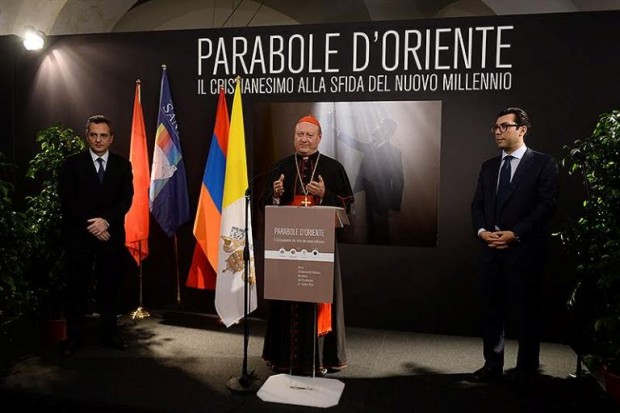
Recently the presentation of an exclusive seven-volume book dedicated to the Armenian Genocide took place in the Pontificial Oriental Institute of Rome’s Santa Maria Maggiore church. Could you please tell about this event?
The author of the work is the member of the Society of Jesus, Georges Henri Ruyssen. The published seven volumes are the result of his years-long work. The book presents documents on the Armenian Genocide, kept in the closed archives of Vatican and the archive of the Eastern Churches Association. The majority of the documents are unknown: Only few of them are known in scientific circles. Especially famous are the letters of Pope Benedict XV, which were addressed to the Ottoman Sultan with the urge to stop the deportation and slaughter [of Armenians]. However, the activity of the Vatican diplomacy in support of the Armenians is properly revealed thanks to these valuable documents, which prove that the Holy See never stopped demanding protection of the Armenians.
These documents have another peculiarity: these are the official documents of a neutral subject, which wasn’t engaged in ally relations with any of the belligerent parties. Consequently, there can be no accusations of non-objective approaches included there.
That day, by the end of the presentation, it was great honor for me to bestow upon Ruyssen the Medal of Honor on behalf of the Armenian President, since this work is important not only in terms of studying the past. It leads us to the tragic reality, to what is going on in the Middle East now.
Vatican is also a large scientific and research center. What measures are taken to establish close scientific and research ties between Armenia and Vatican?
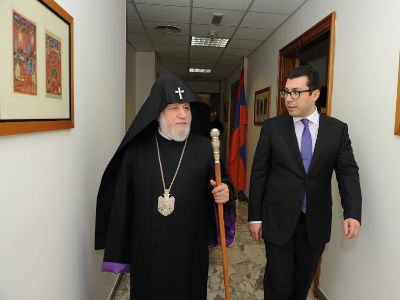
The Embassy promotes not only scientific and research ties. We are trying to establish ties with agencies in such spheres as health, culture and education.
You received higher education in Italy, completing Master’s Degree in International Relations at the University of Trieste and you know Italian. How much does this help you in your work? What advice would you give to the young people who want to study diplomacy?
Knowledge of Italian and my education apparently help me. Although considering the fact that people working in the Holy See know different languages, knowledge of Italian may be insufficient for harmonious work. Nevertheless, I think knowing the language is a necessary factor for the daily work, considering that we are in Rome.
As to the advice, I’ll say the following: if you have made up your mind to become a diplomat, never stop on the path of acquiring new knowledge. One must have firm faith and confidence in the opportunities of one’s country to achieve progress, but it’s no less important to be deeply aware of others’ issues and developments in the world. To advance your viewpoint, you should be able to not be a foreigner among others.