make preferable
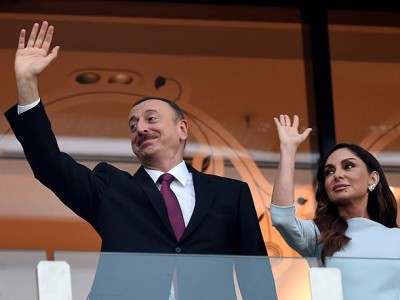
The First Family of Azerbaijan and a close business partner made a series of financial transactions in the days and weeks before a crippling 2015 devaluation of the national currency that eventually earned them at least 100 million manat (US$ 64 million) in just two deals while additionally protecting their banks and companies, according to the Organized Crime and Corruption Reporting Project (OCCRP).
In February 2015, the Central Bank of Azerbaijan depreciated the country’s currency - the manat - by one-third against the US dollar. The surprise move came after months of interventions by the Central Bank designed to prop up the manat and government promises that it would maintain the stability of its currency. As a result, the manat depreciated by another 50 percent within a day.
President Ilham Aliyev reassured the concerned public: “On the contrary, the manat is even stronger,” he told media as devaluation planning was underway. The Central Bank also promised, up to two days before the devaluation, that the currency would remain strong.
The transactions raise questions about what the president knew and whether he or anyone in his administration told his family and business partner of the impending devaluation and whether together they moved to protect their businesses and earn a profit from the crisis.
At the center of the controversy are three banks: Caspian Development Bank, AtaBank and Pasha Bank. The three are owned by either the Aliyev family; their business partner, Ashraf Kamilov; or both.
Caspian Development Bank and AtaBank are linked to Synergy Group a conglomerate, whose 99 percent of the shares belong to Ashraf Kamilov, while Pasha Bank is beneficially owned by the two daughters of Aliyev.
According to the OCCRP data, in January 2015, the Central Bank re-issued the bank’s license, approving a name change to Caspian Development Bank.
Three days later, the bank lent most of its money – US$ 52 million (40.7 million manat) – to SOCAR, the state-owned Azerbaijani oil and gas giant, as a US dollar denominated loan.
The loan was puzzling, as it was for five years at a 6 percent rate, a high rate given international borrowing rates then available to SOCAR.
In addition, that single loan constituted more than 80 percent of the bank’s founding capital – an astounding violation of Azerbaijani banking regulations restricting the exposure to a single client to a maximum of 7 percent.
To make matters worse, the SOCAR loan was completely unsecured, a gross violation of good banking practices that put the bank at further risk, according to a bank audit report.
Then, three weeks later, the Central Bank devalued the manat.
The result was the Caspian Development Bank went from no earnings to a profit of 13 million manat (US$ 12.5 million) from a single deal.
After the second devaluation at the end of 2015 when the currency was floated, the earnings from that single loan tripled to 39.2 million manat (US$ 25.4 million).
As per the OCCRP, other suspicious transaction occurred on February 19, 2015, two days before the first devaluation of the manat. AAC LLC, a Synergy Group construction materials company, restructured the loan it got the previous year from AtaBank in an unusual way: it paid back 60 million in manat (US$ 76.5 million), and immediately re-borrowed a slightly higher amount in US dollars.
The deal was a boon to AAC, which two days later gained about 20 million manat (US$ 19.3 million) from the devaluation. The risky trade was out of character because the company said in its annual report that it had no exposure to currency losses or gains because “all the Group’s sales are domestic and denominated in AZN.”
The deal also helped AtaBank. As a result of the dollar loans and the devaluations, AtaBank earned 61 million manat (US$ 39 million), double the amount of the original loan.
The OCCRP also pointed to the 2015 results of another bank. Pasha Bank is another bank owned by the First Family of Azerbaijan through Pasha Holding and was founded in 2007 by the family of Mehriban Aliyev, the wife of Ilham Aliyev. It is now beneficially owned by daughters Arzu and Leyla, according to the bank’s report.
The bank profited handsomely from currency exchanges, but because it did not report any transactions, it is not clear how the profits were made. The bank did double its foreign currency deposits between 2014 and 2015. The bank earned 35.9 million manat (about US$ 28 million) for 2015 in what it listed as “foreign exchanges and movements,” an almost six-fold increase from the previous year.
The OCCRP noted that the rest of Azerbaijan’s banking sector, however, lost more than one billion dollars from that devaluation and a later Central Bank decision to scrap the manat’s peg to the US dollar and let it float freely.
In early April, the Aliyev family had become a subject of journalistic investigation. The International Consortium of Investigative Journalists (ICIJ), which had obtained the documents of Panamanian law firm and corporate service provider, Mossack Fonseca, informed that Ilham Aliyev’s daughters own 56 percent of a consortium of six gold mining companies. In addition, the Azerbaijani authorities signed a secret agreement in 2006, pursuant to which 70 percent of the profits of companies belonging to the Azerbaijani president’s daughters had fallen to them, and solely 30 percent—to the state.