make preferable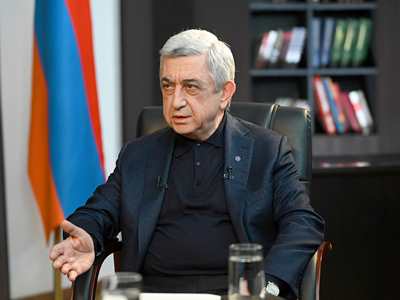
Absolutely, there have been no pressure or no any concession, no written or verbal agreement or arrangement, said Armenia's third President Serzh Sargsyan when asked whether the Armenian side was forced to make any concessions in the negotiation process on the interim or final status of Nagorno-Karabakh in 2016.
Recall that Prime Minister Nikol Pashinyan said that in 2016 there was a radical break in the settlement of the Nagorno-Karabakh conflict, which can be called a catastrophe. He also claimed that at that time Nagorno-Karabakh had lost all practical and theoretical possibilities of being outside of Azerbaijan.
“When I was speaking about the April war and when there was the Commission of Inquiry etc, I had very openly said that there had been only a verbal agreement to stop the war, while they were claiming that maybe there had been some written document, or some concession etc.,” he said.
Asked if a new cease-fire agreement was proposed in 2016, Sargsyan said: “Absolutely. We had not agreed to any new document or any verbal agreement. That had been confirmed by the co-chairmen, when they publicly stated that there was no new document and that the trilateral agreement signed in 1994 remained in force.”
What regards to the 2016 document, if you noticed, inbetween the lines there he was speaking about some letters and what not, and would not clearly say exactly what proposals were made by the co-chairmen in 2016, when those proposals were tabled, etc.
Indeed, in 2016 – that is after the April war – we did receive some proposals by the co-chairmen. And those proposals in no ways violated the red lines that we had always had. Let me reiterate again, that those red lines were the following: first – self-determination of Nagorno Karabakh, second – land border between Armenia and Nagorno Karabakh, third – recognition of Nagorno Karabakh authorities by the international community as legitimately elected officials, and many other such [features] that was [in entirety] called interim status. In one place it was called Nagorno Karabakh interim status, in other file it was called temporary status, somewhere else it was called recognised status. And fourth – something that was based on or was uniting the preceding three aspects in one – was the security guarantees.”
According to Serzh Sargsyan, according to these proposals, peacekeeping forces were to stand between the two conflicting sides.
According to him, the introduction of monitoring mechanisms was discussed in the form of a statement in Vienna and St. Petersburg in 2016, which was certainly very beneficial for the Armenian side, but was not a solution to the problem.
“That was very specific means which would exclude future hostilities.
Pertaining to the UN Security Council, which to my bemusement is called 'catastrophe’, I have to say that it has always been the perception that a UN Security Council resolution [would be necessary]. If someone, who wants to speak about this topic, got detailed understanding of the Kazan document, they would see that the document, or that declaration, had it been accepted, it would need to be approved by the UN Security Council, since it included certain provisions that are generally within the powers of the UN, while the OSCE and moreover its Minsk Group, would not have been in the position of adopting such decisions.”
When asked if this meant that before the April war there was talk of a UN Security Council resolution, he said: “This idea or such a concept was featured in all of the documents. It was not inscribed in any of the documents that exactly that one has to be sent to the UN Security Council. Why am I putting it this way? Because in 2016 we were offered a docket with three different documents in it. I have already spoken about this in other occasions: one was meant to be a Declaration between Armenia and Azerbaijan. The second one was to be a joint statement adopted by the Foreign Ministers of the co-chairing countries, which had to include certain elements that were not acceptable for Azerbaijan and Azerbaijani President did not want those to be part of the bilateral document; and third document was a draft UN Security Council resolution which was wrapping up or was interweaving the other two documents and was also adding some other provisions on its own behalf.”