make preferable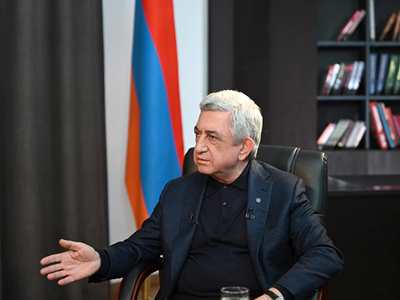
The details of the referendum on the final status of Nagorno-Karabakh were never discussed because those details were left until the main agreement, said third President of Armenia Serzh Sargsyan.
According to him, the main parameters were fixed, which is of vital importance for us.
To clarify, that is, the wording of the question was not discussed, he said: “No, of course not. All this, I repeat again, was provided for in this agreement. This is clear. You will see no place in these documents, at least in the proposals that concerned the basic principles, in any document, even a hint that before the final settlement of the problem, the Azerbaijanis must return to the very territory of Nagorno-Karabakh.
There is no such thing ... Let them show at least one document where there is a hint of this ... I say again, it was a problem of a big agreement, where our position would be as follows: Azerbaijanis can participate in a referendum exactly the same way as they participate as residents of Nagorny Karabakh in the parliamentary elections in Azerbaijan. They don't come to vote. Let them, wherever they are, vote and vote in favor of Azerbaijan. And our population would vote in favor of Armenia."
Asked that the proportions would be according to the situation in 1988, Sargsyan said: “Yes. We have always said, and this in no way belittles our work, that yes, we accept that the temporarily displaced must return to their places of permanent residence. But this can take place only if and only if the issue of the authorities in the given territory, which will be responsible for the safety of these people, is resolved. Well, you don’t recognize Nagorno-Karabakh as a state, but who will provide if these people return. For example, who will ensure that the few Azerbaijanis living in Stepanakert return to Stepanakert.
You can't assign a policeman or a peacekeeper to every Azerbaijani or Armenian. Not? That is, we will return again to 1988. And this is the reason why none of the co-chairs has ever said that you are wrong in response to what we said. We are talking about the return of those Azerbaijanis who lived in those territories that were transferred to Azerbaijan as a compromise.
However, with certain conditions. I don't want to go into details... I don't know if they live with us now or not. But after the war, this was already the subject of Azerbaijan's decision. Then it was not the subject of Azerbaijan's decision. This is stated in the draft resolution of the UN Security Council, and in other documents. So these are very obvious things."
"That is, I do not understand - what does he want? He wants us to say, no, not a single Azerbaijani should be in the territory of Karabakh at all. Does he want us to say it? We have never had such an approach. I simply do not understand a person who literally repeats the words of the one who humiliated him as a person, humiliated him as a head of state, humiliated him as a representative of the Armenian people.
Well, if at the initial stage, when he naively believed that now, bypassing the co-chairs, he would come to some agreements with Azerbaijan, okay, you can understand this somewhere. But after a disastrous war, when you were called a “drunk clown” (I don’t want to repeat insults even against him), but after such humiliation by this person, do you repeat his words? Do you repeat what he said, citing it as an argument? I don't understand it."
Commenting on the Prime Minister's statement that Armenia and Azerbaijan have never managed to agree on the timing of the referendum, Sargsyan noted: “Yes, because we had no particular desire to agree on the timing issue, and I spoke, and now I repeat that Azerbaijan could never even agree to a referendum. But that's why I say that the only way to resolve the problem is a package solution. And the package solution does not give one of the parties the opportunity to get what it wants, and then say, you know, the rest with conditions ... That is why five districts surrendered, and two remained. Until the referendum passed, these two - Lachin and Kelbajar should have remained ...
Aliyev, not only admitted this. Aliyev, after the April war, those documents received, which this one calls a catastrophe, Aliyev believed that he was being forced to recognize independence behind closed doors. So their opinions still differ, probably, but I am sure that in these circumstances Aliyev changed his mind.
So the Azerbaijanis had a choice: either hold a referendum, release Karabakh as a very legitimate member of its composition, or leave Lachin and Kelbajar there. And if it was beneficial for them, let them do it, but Lachin and Kelbajar - you saw, the Armenians forcibly resettled from other places moved there, and from those five regions they also moved there and would live as long as the Azerbaijanis would want hold a referendum. Peacekeepers would stand, the Armenian army, the self-defense forces of Nagorno-Karabakh - all this would be, and there would be the approval of the international community. Then the resumption of hostilities would be much more painful for Azerbaijan.”
Commenting on Pashinyan's statement that he sent a letter to the co-chairs, in which they asked to restore the provision on the national composition according to the situation in 1988, Sargsyan said: “Yes, I sent letters. I sent letters a year before the Kazan document, substantiating our corrections, corrections in the existing document. And as a result, the Kazan document became more acceptable to us than the previous document was. And here I have no arrogance to assert that it was this letter that served as the basis for it to be so. But the result was this.
I sent the second letter after the April war, and we received proposals that were in no way inferior to those contained in the Kazan document. And I do not even have those expectations that if I send this letter to the powerful of the world, then 10 out of 10 of my proposals should be fulfilled. This is also, so to speak, a matter of negotiation, so ... if these are bad letters, let them publish. Let's see if these letters will bring us honor or damnation. Let him publish. Let him write a couple of such letters."
To clarify, this provision, related to the national composition of 1988, existed at some time, then disappeared, Sargsyan noted that “this provision has never disappeared."
"Never. And those documents that he considers pernicious, in these documents it is very clearly noted that all those issues that are not included here are included in previous documents that have been deposited with the OSCE depository. That is, this must be understood very clearly: see the Kazan document. What else should be?"