make preferable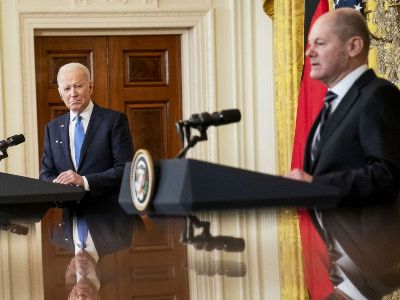
German Chancellor Olaf Scholz's meeting with US President Joe Biden made one thing clear — Berlin and Washington are still not on the same page when it comes to Russia, foreign policy expert Gerhard Mangott told DW.
During his visit to Washington, Scholz sought to emphasize Germany's commitment as an ally in the growing Ukrainian-Russian crisis.
Although they represented a united front, their statements also revealed Berlin and Washington's disagreement with Russia, according to Mangott.
Scholz met with US President Joe Biden at the White House on Monday, in what Mangott described as a bid for the chancellor to show that Germany is a "reliable ally" when dealing with Moscow.
Scholz said during the meeting that they will "act together" and "far-reaching" measures against Russia had been agreed upon by allies.
Nevertheless, according to the Austrian expert, there were differences between the two sides, especially with regard to the Nord Stream 2 pipeline and possible sanctions against Russia. "It was really noticeable that after Biden confirmed that Nord Stream 2 would not go ahead after a Russian incursion in Ukraine, Scholz did not want to state that explicitly as well," Mangott said.
The Austrian expert said it's unclear whether Germany will really be willing to shut down the controversial pipeline project.
"On the other side, Biden has made clear even if the Germans don't do it, we have the means available to stop it and we will stop it," Mangott added.
Mangott said it's noteworthy that Germany and the United States have not clearly stated "what kinds of sanctions will be imposed in the case of the Russian incursion." He said there seems to be "disunity" not only between Germany and the US, but also other NATO allies.