make preferable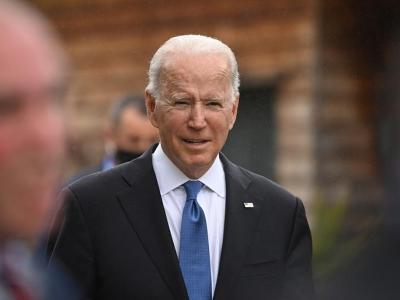
US President Joe Biden wrote an article for The Washington Post, in which, in particular, he shared his thoughts on the situation in the Middle East, as well as US achievements and plans for this region.
“Next week, I’ll travel to the Middle East to start a new and more promising chapter of America’s engagement there. This trip comes at a vital time for the region, and it will advance important American interests,” the US President noted in his op-ed.
A more secure and integrated Middle East benefits Americans in many ways, he said.
“Its waterways are essential to global trade and the supply chains we rely on. Its energy resources are vital for mitigating the impact on global supplies of Russia’s war in Ukraine. And a region that’s coming together through diplomacy and cooperation — rather than coming apart through conflict — is less likely to give rise to violent extremism that threatens our homeland or new wars that could place new burdens on U.S. military forces and their families.,” Biden said.
However, he notes the need to avoid such a scenario.
The US President went on to describe the difficult situation in the Middle East prior to his inauguration.
After his predecessor, Donald Trump, abandoned the nuclear deal, he said, Iran passed a law mandating the rapid acceleration of its nuclear program. "Then, when the US administration tried to condemn Iran for these actions in the UN Security Council, the United States found itself isolated and alone."
Joe Biden noted that in the first weeks of his presidency, US intelligence and military experts warned that the region was under "dangerous" pressure.
“In my first weeks as president, our intelligence and military experts warned that the region was dangerously pressurized. It needed urgent and intensive diplomacy. To restore deterrence, I ordered airstrikes in response to the attacks against our troops and began serious diplomatic outreach to bring about a more stable region,” Joe Biden described the actions of his administration.
Noting the completion of the US combat mission in Iraq and the attempts made to achieve a truce in Yemen, he returned to the topic of Iran.
“With respect to Iran, we reunited with allies and partners in Europe and around the world to reverse our isolation; now it is Iran that is isolated until it returns to the nuclear deal my predecessor abandoned with no plan for what might replace it. Last month, more than 30 countries joined us to condemn Iran’s lack of cooperation with the International Atomic Energy Agency on its past nuclear activities. My administration will continue to increase diplomatic and economic pressure until Iran is ready to return to compliance with the 2015 nuclear deal, as I remain prepared to do,” the US president wrote.
Biden spoke about his efforts to end the war in Gaza. According to him, the US has restored ties with the Palestinians, providing them with about $500 million and Israel with more than $4 billion.
He also talked about the sanctions imposed on Saudi Arabia in connection with the murder of journalist Jamal Khashoggi, as well as the release of American citizens detained in Saudi Arabia long before he took office.
“From the start, my aim was to reorient — but not rupture — relations with a country that’s been a strategic partner for 80 years. Today, Saudi Arabia has helped to restore unity among the six countries of Gulf Cooperation Council, has fully supported the truce in Yemen and is now working with my experts to help stabilize oil markets with other OPEC producers.
“As president, it is my job to keep our country strong and secure. We have to counter Russia’s aggression, put ourselves in the best possible position to outcompete China, and work for greater stability in a consequential region of the world. To do these things, we have to engage directly with countries that can impact those outcomes. Saudi Arabia is one of them, and when I meet with Saudi leaders on Friday, my aim will be to strengthen a strategic partnership going forward that’s based on mutual interests and responsibilities, while also holding true to fundamental American values,” he noted.