make preferable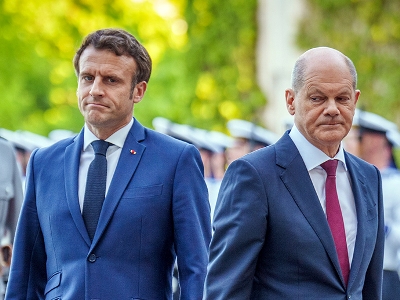
The relationship between France and Germany is at the heart of the European project and is key to European stability, but the alliance is falling apart. The war in Ukraine has exacerbated the shifting center of influence of the European Union toward Central Europe - Germany and its eastern neighbors-where, unlike Germany, France's position has never been relatively impressive. Both countries have disagreements over the energy crisis prevailing in Europe and their defense policies. What the growing disagreements will mean for the EU in the midst of the Russia-Ukraine war, when Europe needs more cooperation, writes Modern Diplomacy.
Both countries have the two most significant economies on the continent; they are considered pillars of the EU. However, when the Russia-Ukraine war broke out, disagreements between the two countries on issues such as energy, defense and the economy reappeared. The gap was further exacerbated by the Russian gas shortage and its impact on the economy. This crisis has demonstrated the fragility of European economies as Europe prepares for a cold winter with an intensifying energy crisis. In addition, the crisis has raised concerns about the EU as a whole and whether it can meet the demands of its citizens.
Two major areas of disagreement are energy and defense. The war in Ukraine and the subsequent disruption of energy supplies have put energy at the top of Europe's political agenda.
At the end of September, Germany announced a large energy support package worth 200 billion euros. This did not sit well with the French president. He was annoyed that Germany did not inform him in advance about ensuring European security. According to French officials, the German package would lead to even greater economic division, and the government in Berlin would potentially distort competition within the bloc by subsidizing energy for business.
In Paris and other European capitals, which are worried about the impact of the war on their own energy costs, Germany's unilateral decision to spend up to 200 billion euros to subsidize skyrocketing gas prices has caused uproar. It also contradicts EU-wide energy restrictions and increases in joint EU borrowing to reduce the pain of rising gas prices. Both the Germans and the French disagree about which energy source should be used.
When it comes to defense, another question arises, as evidenced by Berlin's recent military procurement decisions. Germany decided to spend part of its newly created investment fund of 100 billion euros on American F-35 fighter jets, much to the annoyance of Paris. These purchases were a serious blow to long-standing efforts to cooperate with France in the development of next-generation fighter planes and tanks.
Likewise, Macron sees such moves as counterproductive to Europe's long-term need to strengthen its own defense. Paris is also frustrated by the slow progress in developing the Future Combat Air System, Europe's flagship defense project launched by Paris and Berlin in 2017 to strengthen the continent's military capabilities. There are concerns about Germany's long delay in supplying weapons to Ukraine.
Moreover, Germany and 14 other European countries, with the exception of France, signed the Heavenly Shield initiative on the sidelines of the last NATO conference. It was reached despite French and Italian cooperation on the Mamba anti-missile project.
There are disagreements over EU energy policy priorities, also related to the evolving fuel crisis. Keep in mind that the parties come from different positions: Germany faces a direct threat from supply disruptions to the sustainability of its entire economy, while France, which currently relies on a combination of nuclear and alternative energy, is theoretically less dependent on hydrocarbons, and Russian gas in particular. The French leadership can therefore work to at least partially pursue a green course within the EU, more readily endorsing the introduction of threshold pricing for Russian oil and gas, while their German counterparts should replace depleted energy sources as soon as possible, even if that means underperforming on environmental indicators.
France and Germany disagree on how to deal with Europe's energy or security crisis. It is worth saying that these disagreements are probably exacerbated by the fact that the balance of power in Europe has been shifting away from Germany over the past couple of years. Scholz has not enjoyed the same political respect as Merkel, and Germany's reckless dependence on Russian gas looks shamefully naïve.
Two of the EU's strongest and richest members have historically dealt with sporadic conflicts in their union. The bloc's stability is threatened by Russia's conflict in Ukraine, and other members, such as Poland and the Baltic states, have challenged the authority of Paris and Berlin.
The rift between Germany and France is likely to worsen. This is especially noticeable in light of accusations against countries with little political and economic power, such as Poland and the Baltic states, that they are questioning French and German leadership in the EU. The viability of a geopolitical Europe built on the wreckage of World War II has been called into question because of the difficulties it has faced, the size and consequences of which may not be evident in the near future.
In the end, what is needed today is a renewed partnership between France and Germany, not the alienation of the two countries. Both are considered engines of European unity and cooperation, so they must cooperate because these states recognize the importance of European unity and cooperation, which have made the Franco-German pair so powerful and influential.