make preferable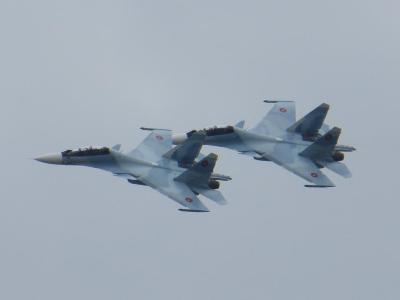
Armenia is rumored to be "interested" in India supplying weapons and training pilots for its Russian-made Su-30SM "Flanker" fighters. While such an arrangement has not been confirmed, New Delhi could certainly make a marked improvement in Armenian aircraft. But is this really a priority for Yerevan? Paul Eden writes about this in his article for Forbes.
"What makes the Indian Su-30MKI different from the Flankers operated across the world is that it is a beautiful integration of various weapons, sensors, and avionics from all over the world," an ace Indian fighter pilot told local media in January.
The missiles include a variant of India's BrahMos supersonic air-launched cruise missile, giving the Su-30MKI a significant countermeasure capability, and the Astra air-to-air missile out of range (BRAAM), among others.
Defense ties between India and Armenia have intensified markedly in recent months. Yerevan has become the first foreign customer for the Indian-made Pinaka multiple rocket launcher (MLRS), ordering four batteries worth about $250 million in 2022. In addition, the two countries are concerned about the growing trilateral military ties between Turkey, Azerbaijan and Pakistan. Therefore, it would make sense for them to cooperate to improve Armenia's Su-30 fleet.
On the other hand, Yerevan may have doubts about additional investments in these aircraft.
Armenia purchased four Su-30SMs in 2019. Nikol Pashinyan's government praised the purchase of modern fighters, saying the country was finally moving away from seeking cheap, low-tech second-hand systems from the Soviet era.His optimism proved fatally premature. Armenian flankers were inactive throughout the 2020 Nagorno-Karabakh conflict because they lacked critical weapons, especially air-to-surface guided munitions. Sending these jets into combat with unguided missiles would undoubtedly have resulted in casualties and almost no discernible gains on the battlefield.
During that war, Azerbaijan destroyed several Armenian air defense systems using Israeli-made Harop bouncing munitions. Baku's successful use of such weapons amply demonstrated that Yerevan had made the fatal mistake of spending most of its limited military budget on a handful of flashy flankers at the expense of the nascent drone industry.
Initially, Armenia had hoped to purchase at least a dozen Su-30SMs. On the other hand, selling the existing four aircraft back to Russia would likely prove impractical in light of the Russian invasion of Ukraine. Last March, Yerevan already denied rumors that it had transferred its flankers back to Moscow for use in the war.
In addition, any purchase of additional Su-30s by Armenia could prompt Azerbaijan to respond by acquiring modern fighter jets. Baku could well use the Armenian purchase, which Yerevan cannot afford, as a pretext to finally acquire the JF-17 Thunder fighter jet that it has been eyeing for years, jointly developed by China and Pakistan. A dozen JF-17 Block 3 fighters armed with China's PL-15 BVRAAMs would significantly strengthen Azerbaijan's air force and likely negate any advantage that additional flankers would give Armenia.
Therefore, Yerevan might settle for something in between. It can request Indian expertise and systems to improve its four flankers it already has, so that they can be something useful in the event of a new war with Azerbaijan, which is still possible.
Indian engineers could modify the aircraft to equip it with Astra and even BrahMos, potentially allowing Armenia to strike targets deep inside Azerbaijan. Baku has already upgraded its Soviet Su-25 attack aircraft. Those aircraft are capable, among other things, of carrying Turkish-made weapons, including the SOM long-range cruise missile.
Such an arrangement could help Armenia save face by proving that the initial acquisition of the Flanker was not a waste thanks to the unique capabilities India can provide.