make preferable
Armenian economist Suren Parsyan's article on "Dramatic growth in the amount of Armenia-Iran trade and development of bilateral relations" was published in Persian in the Islamic Republic News Agency (IRNA).
Below we present the English version of this article.
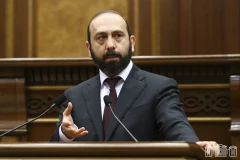
Armenia and the Islamic Republic of Iran have millennia of diplomatic, political, and economic relations, and an inviolable border which has been one of the important factors of the region's stability and prosperity. Of course, the mutually beneficial relations and projects between the two countries always need improvement, and one of them was announced on December 27, 2023. During a news conference in Yerevan, Armenian Foreign Minister Ararat Mirzoyan and Iranian Foreign Minister Hossein Amir-Abdollahian announced the opening of the Consulate General of the Republic of Armenia in Tabriz. The possibility of opening an Armenian consulate in Tabriz proves once again that the Iranian authorities tend to conduct a multi-vector and long-term foreign and domestic policy.
By founding the Consulate General of the Republic of Armenia in Tabriz, in addition to the Eastern Azerbaijan, it will be possible to expand the consular service area to other regions adjacent to the Republic of Armenia, including the Western Azerbaijan, Ardabil, Gilan, and Mazandaran Provinces of the Islamic Republic of Iran, which will contribute to the development and strengthening of economic, cultural, and educational ties between these regions. Currently, two consulates have the opportunity to provide consular services in such a wide area: the consulates general of Turkey and Azerbaijan.
It is worth reminding that after the establishment of the Soviet power in 1920, Armenia also had a consulate in Tabriz, but it was dissolved after the formation of the Soviet Union. Therefore, the opening of a consulate can also be considered an important step towards the restoration of historical and traditional ties between the two brotherly peoples.
The opening of the Armenian consulate in Tabriz should be viewed as a mirror response to the opening of the Consulate of the Islamic Republic of Iran in Kapan (Syunik, Armenia) (2022). First and foremost, the opening of the Armenian and Iranian consulates has a political and security component and is aimed at ensuring the north-south corridor. Certainly, it can prevent the opening of the Turkish-Azerbaijani so-called "Zangezur corridor." The territorial integrity and sovereignty of the Republic of Armenia and the Islamic Republic of Iran are a red line, the destructive and aggressive behavior and propaganda of other countries directed against Armenia and Iran must be stopped by all possible means, including diplomatic ones. And in general, are the countries that want a corridor through the territory of Armenia ready to give such corridors through the territory of their country to other countries? I think not.
The consulates operating in Tabriz and Kapan can contribute directly or indirectly to the construction of the North-South road corridor. In particular, on October 23, 2023, a new contract was signed between the Armenian government and three Iranian companies, in accordance with which the Iranian side will build the Agarak (Iranian border)-Vardanidzor-Kajaran tunnel road section: 32 km (Syunik, Armenia). The activities of Iranian construction companies in this region of Armenia has not only economic, but also security and political significance. Let me remind that according to the Turkish-Azerbaijani plan, it was through Agarak (Meghri) that they planned to pass the so-called "corridor." Iranian construction companies can include workforce, equipment, tools, and building materials from Tabriz and other bordering regions in the construction of this road section, and this will stimulate economic activity in this region.
It is also clear that the opening of the Consulate General of the Republic of Armenia in Tabriz can be a new impetus for the development of trade and economic relations between the two countries. It should be noted that the trade between Armenia and Iran has increased dramatically in recent years. In particular, in 2022, about $526 million worth of goods were imported from Iran to Armenia, which is three times more than in 2017, and 20 percent more than in 2021. Natural gas, construction materials, ironware, dairy products, dry and fresh fruits, tomatoes, etc. are mainly exported from Iran to Armenia. In 2022, exports from Armenia to Iran amounted to $102.3 million, which is 56.1 percent more than in 2021. Electricity, scrap metal, cigarettes, beef, lamb, etc. are mainly exported from Armenia to Iran.
That is, it can be recorded that the rate of growth of the export of Iranian goods is greater than that of the Armenian one. Certainly, the export of Iranian goods has been considerably facilitated by the temporary free trade agreement signed between the Eurasian Economic Union—EAEU, of which Armenia is also a member and the only one that has a land connection with Iran—and the Islamic Republic of Iran, thanks to which 306 Iranian goods can be exported to Armenia, Russia, Belarus, Kazakhstan, and Kyrgyzstan with zero customs duties. It is planned that this free trade agreement with Iran will become permanent in 2024.
At the same time, the permanent free trade agreement and the opening of consulates in both countries will contribute to the development of cooperative relations. In particular, in recent years, Iranian tomatoes and dairy products are being processed in Armenia and exported to the EAEU and other European countries. It is appropriate to note that Armenia has free trade agreements also with the European Union, the USA, Japan, and [several] other countries; that is, the goods processed in Armenia can be exported to countries that have closed or limited the import of Iranian goods.
Of course, the Armenian consulate in Tabriz can also serve the visits of Iranian and Armenian tourists, providing them with information and other consular services. Every year, more than 200,000 Iranians arrange their vacations in Armenia, while Iran—in particular, Tabriz—can be one of the preferred destinations for Armenian tourists, considering the Armenian-Iranian historical and rich heritage. This will become a new impetus for the development of tourism infrastructure between the two countries.
In parallel with the active and effective programs being implemented by Iranian Armenians, steps should be taken now towards developing educational and cultural ties between Armenia and Iran. In particular, consulates should assemble around them intellectuals, teachers, lecturers, university students and schoolchildren, organize mutual visits, and implement joint programs that will enable to communicate with each other not as tourists, but in a practical way.
Summing up, it should be recorded that the deepening of political, socioeconomic, and diplomatic relations between the Republic of Armenia and the Islamic Republic of Iran is not directed against third countries, an these relations are based on the principles of dignity, wisdom, and mutual benefit. The results of joint Armenian-Iranian programs can be used not only by the region, but also by other countries.