make preferable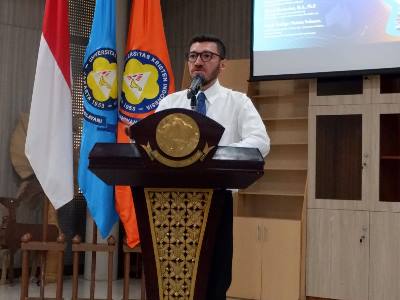
By Taguhi Melkonyan
Syria, Cyprus, Armenia, Australia, China, Indonesia. These are the countries where orientalist and internationalist Ararat Kostanian has studied and gained the best professional experience. The next stop of study is Universitas Islam Internasional Indonesia (UIII) . In the country with the largest Muslim population in the world, Ararat Kostanian was interested in the social cohesion of the Christian minority and the Muslim majority and became the basis for conducting scientific research on that topic.
In an interview with Armenian News-NEWS.am, Kostanian talked about the reasons for studying in Indonesia, the educational experience of that country, his experience in establishing academic relations with Indonesia, the prospects of developing Armenia's cooperation with Southeast Asian countries, and some other matters.
Ararat Kostanian is a former researcher of the National Academy of Sciences of Armenia, an academic member of the Beijing Foreign Studies University (China), a member of International Movement for a Just World (JUST) of Kuala Lumpur (Malaysia), a member of the Usanas Foundation of India, and a researcher at the US-Asia Institute (Washington).
How did you decide to study in Indonesia? Wasn't it difficult to adapt in one of the countries with the largest population in the world, with which Armenia has considerable civilizational and cultural differences?
I should note that this is not my first visit to the region. I lived and worked there for several years due to the family art business. I first visited that region in the early 1990s. After many years, I decided to continue my studies at the Universitas Islam Internasional Indonesia , considered one of the best universities in Southeast Asia, as a Doctor of Social and Political Sciences.
What are your impressions of the country and population with the largest Muslim population in the world?
I am impressed by the culture of that country, the example of peaceful coexistence of the multi-million population. I can state that currently the government and the people of Indonesia are experiencing great development together. The country plans to turn into another Asian giant in the list of developed countries in 2049. The increase in development in the fields of economy, technology, and education is evident. In addition, Indonesia is known for its rich natural resources. It has the largest production of nickel in the world, is the second largest producer of cobalt, and is also one of the world's leaders in the field of agriculture, especially in the cultivation and export of coffee. Also, Indonesia controls one of the world's most important waterways for international trade.
Many changes in the social and political atmosphere are taking place parallel to the change of the world order, from a unilateral system to an international arena, with multipolar players. As a key player, Indonesia is the driving force behind ASEAN's success story. As a country that recently hosted the G20 conference, it shows its willingness to establish neighborly relations with all through its foreign policy. It is able to establish effective relations with both China and the USA.
Religion is an important part of social and political life in Indonesia, and Islam is based on the recognition and acceptance of local and other traditions; it is primarily advocating solidarity and based on moderation. It is interesting that Indonesia was able to alienate extremist views in a short period of time to the level that religious intolerance does not play a decisive role in social and political life. The people are generally friendly, even towards foreigners. It is surprising, but during these years I have not seen any discrimination against foreigners. However, there is caution towards foreigners due to the potential negative phenomenon of colonization.
Are you satisfied with the education system of that country? If we draw parallels with the education system of our country, what commonalities or differences can you point out?
In Indonesia, the education sector is a part of the development strategy that this country is guided by. Many scholar and students are studying in the best international universities and have been working for several decades to improve the education sector and the country. Even after independence, the Indonesian government allowed experts who graduated from the best universities to participate in the reconstruction of the country through consultations. It was then known as the Berkeley team. Later, a team of graduates from the Australian National University, of which I am also a graduate, came forward with such an initiative. The university where I am going to do my PhD is part of Indonesia's national strategy to create a world-class international Islamic university that is unique in its modern outlook and open to all religions and races. Scholars are the graduates of best international universities, we also have visiting professors from developed countries and prestigious universities. Moreover, we have joint degrees with the most prestigious universities in Great Britain.
The topic of your doctoral work is quite complex and multi-layered. Why did you choose the topic of social cohesion theory between the Christian minority and the Muslim majority? And why did you decide to draw parallels between Indonesia and Syria?
When I was giving a lecture about the Syrian war at the prestigious International Institute of Advanced Islamic Studies in Kuala Lumpur (Malaysia), I realized that there was a great interest in Christian-Muslim peaceful coexistence among scholars, so I thought it was worth starting a new research on that topic. Moreover, by getting to know Indonesia, I intend to do a historical comparative analysis between Syria and Indonesia, where a new theory of social cohesion can emerge from the study of Christian minorities and Muslim majorities in both Syria and Indonesia, and in this regard, the Armenian community of Syria in particular can be a subject of study.
While writing my doctoral dissertation on the topic "The Theory of Social Cohesion between the Christian Minority and the Muslim Majority in Indonesia and Syria," in addition to using academic sources, I conduct interviews with leaders of religious and political communities in Syria and Indonesia, historians, residents, scholars who have studied the issues of Christian and Muslim coexistence both in Indonesia and Syria.
Have you tried to look for Armenian traces in Indonesia? Have you discovered new pages of Armenian-Indonesian history?
That field is really very interesting, especially if you are a researcher. I am familiar with the academic works published on the historical Armenian communities in Malaysia and Singapore. Unfortunately, such a work does not yet exist which deals with the Indonesian Armenian community. I intend to fill that academic gap and write a paper about it. Recently, on my initiative, a Yerevan State University delegation visited the Universitas Islam Internasional Indonesia to participate in the international conference dedicated to Armenian and Indonesian academic relations, during which I presented a report on the historical role of the Armenian community in Indonesia, making reference to sources that were not known even to many Indonesian scholars. I believe that working in the direction of academic diplomacy is important not only for the development of relations between scholars, but also between people and countries in general.
Armenians settled in Indonesia as early as the 17th century, mostly merchants. What lasting values are there in that country that the Armenians left behind?
Currently, in the city of Surabaya, there is an Armenian church founded by the Jugha Armenians, which today belongs to the Christians of Indonesia. In the same city, there is also a hotel founded by Armenian businessmen Sarkissian, which is now called Majapahit.
Should Armenia deepen its relations with Southeast Asian countries? What will such cooperation give us?
In the rapidly changing world, during the period of the fourth industrial revolution, Armenia should actively cooperate with all, particularly Asian countries, taking into account the rapid development of Asia. Many scholars today believe that the world is "moving" to Asia. To do this, we must first have enough knowledge about the civilizational role of Asia, its developing mechanisms, and at the same time active cooperation and presence in international trade with Asian countries such as Indonesia. Unfortunately, we're falling behind, but it's not too late to move forward.
In what domains can Armenia and Indonesia cooperate? Are there any promising directions that can be mutually appealing?
Armenia and Indonesia are countries that created civilization with rich history and culture, and both value their historical achievements by combining them with current lifestyles. In this sense, cultural interactions can be essential not only for getting to know each other, but also for creating mutual values. Also, both countries have agricultural products that are well known in regional and global markets. Thus, cooperation and trade in that direction would be beneficial for both countries. Moreover, the IT and technology sectors are booming in both countries. For example, Indonesia recently welcomed the leaders of global companies such as Apple and Tesla to set up industries in Indonesia. As an example, Armenia can present the TUMO project in Indonesia, becoming an Armenian technological hub in the center of rapidly developing Asia. Also, it is important for Armenia and Indonesia to cooperate strongly in the social and political spheres. Armenia's cooperation with a Muslim-majority country can be a good indicator of such countries for those who build their politics on intolerance and hatred.