make preferable
How are countries overcoming geopolitical divides to create the best way to connect economies, spur investment and growth? Are landlocked countries taking on a new role as key hubs in the emerging era of land connectivity? How can the Crossroads for Peace initiative of Armenia contribute to peace and economic development in the South Caucasus and beyond? The panel discussion entitled "Geopolitics of Connectivity: From Competition to Collaboration" was dedicated to these questions at the Yerevan Dialogue 2024 international forum.
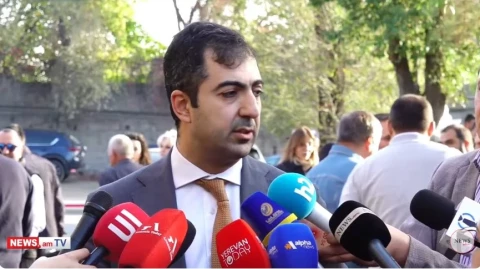
Discussant Ruben Rubinyan, deputy speaker of the National Assembly of Armenia the latter’s special representative for the normalization of relations with Turkey, said that there is a misconception that the historical past is the reason why Armenia and Turkey do not have diplomatic relations. But in fact, for all the governments of Armenia, according to him, history was not at the basis of the strategy to normalize relations with Turkey, and Armenia has always been open to normalizing of relations and reopening of borders with Turkey.

Peter Szijarto, Minister of Foreign Affairs and Foreign Economic Relations of Hungary, answering the question of how the Crossroads of Peace initiative can contribute to peace and economic development in the South Caucasus, said that Hungary is one of the countries affected by the 40-year Cold War, and also borders Ukraine, which has been at war for the third year. According to him, if there are countries in the world that realize and appreciate the importance of initiatives aimed at peace and economic cooperation, then Hungary is undoubtedly one of those countries.
The world is again divided into different blocs, he said, adding that Hungary is against such a world order and is in favor of creating favorable conditions for cooperation between the East and the West.

The FM of Hungary noted that his country can play such a role in the South Caucasus, particularly in the normalization of relations between Armenia and Azerbaijan.
"Because we can talk to both sides of this conflict, based on mutual respect in both cases," he said, adding that the peace treaty between Armenia and Azerbaijan could be signed in the Hungarian capital, Budapest.
How can countries overcome geopolitical divisions and create ways that connect countries to each other, create an economy for the welfare of their people?

Lazar Comanescu, Secretary General of the Permanent International Secretariat of the Black Sea Economic Cooperation Organization, answering this question, said that first of all there should be fair and equal competition. When competition becomes a tool to dominate and control, then it is no longer competition and it does not work, he added.
Comanescu added that in terms of eliminating the aforesaid divisions, it is important that these initiatives are created by the countries of this region.
Addressing the question of whether landlocked countries have a new role as key hubs in the emerging era of land connectivity and how Kazakhstan—as such a country—has faced this matter, Deputy Foreign Minister of Kazakhstan Alibek Kuantyrov said that countries should not act alone, but trade, together with partner countries and cooperate not only with bordering countries, but also with non-bordering ones. Kuantyrov added that Kazakhstan currently cooperates closely with Armenia in several domains and is also ready to contribute to efforts to establish peace and stability in the region.

David Bertolotti, Deputy General Secretary of the French Ministry of Europe and Foreign Affairs, answering the question about what role the EU can play in making the Crossroads for Peace initiative a reality, said that they fully support Armenia and Azerbaijan in signing the peace treaty as soon as possible and welcome the progress made in the border delimitation work.
"One of our messages in this regard is that interdependence should not become a weapon. It should not become a way to exert pressure, so that, for example, the given country opens an extraterritorial corridor, or imposes the presence of another country's forces on the territory of another country," Bertolotti said, adding that "the interdependence of countries in the region should be truly mutually beneficial, based on the country's on the principles of sovereignty, jurisdiction, as well as equality and reciprocity". According to him, this also applies to the reopening of borders.

Bertolotti added that France is actively engaged in implementing various projects in Armenia and the region. In particular, soon France will have an expert in Armenia who will deal with the issues of interdependence of the countries. As far as the EU is concerned, the Global Gateway initiative is one of the leading projects, which implies EU investment of about 2.5 billion euros for Armenia until 2027.