make preferable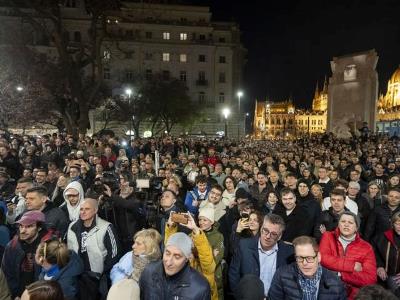
On Thursday, hundreds of thousands of Hungarians filled the streets of Budapest during competing demonstrations as supporters of the country’s two main political movements staged shows of strength ahead of next spring’s national elections, Associated Press reports.
The rival rallies highlighted a confrontation between nationalist Prime Minister Viktor Orbán and his main political challenger, Péter Márki-Zay, who appears determined to challenge the long-time Hungarian leader in what could be the most competitive election of Orbán’s 15-year rule. The election is scheduled for April, though an exact date has not yet been set.
Orbán’s supporters gathered Thursday morning on a bridge over the Danube and marched toward the neo-Gothic Hungarian Parliament building. Organized under the banner “Peaceful March”, the rally coincided with Hungary’s national holiday on October 23, commemorating the 1956 anti-Soviet uprising suppressed by the Red Army.
Marchers chanted slogans in support of Orbán and his claims that foreign powers threaten Hungary due to its direct involvement in Russia’s war in Ukraine. A large banner at the front read: “We don’t want to die for Ukraine.” At the end of the march, Orbán addressed the crowd from a square near the Parliament, delivering a speech filled with hostility toward both Ukraine and the European Union — frequent targets of his ire. He accused Kyiv’s European supporters of dragging the EU into the war and of being willing to send others to their deaths.
Considered the EU’s closest ally of Russian President Vladimir Putin, Orbán has consistently opposed Western support for neighboring Ukraine since Moscow launched its large-scale invasion on February 24, 2022. He has maintained warm relations with the Kremlin while holding a bellicose stance toward Kyiv. The Hungarian leader has also strongly opposed Ukraine’s aspirations to join the EU-27 and has called for an immediate ceasefire in the conflict, though he has not addressed what this might mean for Ukraine’s territorial integrity or European security amid the ongoing war.
During his roughly 40-minute speech, Orbán claimed that Ukraine had “long ceased to be sovereign, independent, or fully self-sufficient.” He emphasized that while he supports strategic partnerships between the EU and Kyiv, Ukraine “cannot be part of our military or economic alliance. They will wage war, take our money, and destroy our economy.”
Later on Thursday, opposition leader Péter Márki-Zay’s supporters filled one of Budapest’s central squares and surrounding streets for their own rally, both protesting the government and demonstrating support for Márki-Zay and his centrist Tisza Party. Participants chanted anti-government slogans, including: “Russians, go home!”