make preferable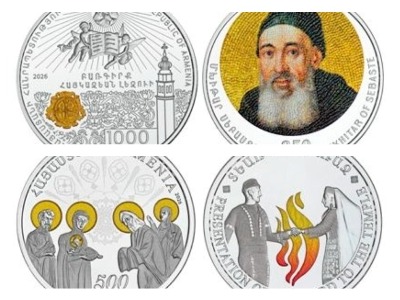
The Central Bank of Armenia (CBA) on Thursday will put into circulation the “350th birth anniversary of Mekhitar of Sebaste” silver collector coin and the “Presentation of the Lord to the Temple” silver and gold collector coins, the CBA informs.
Collector coin dedicated to the 350th birth anniversary of Mekhitar of Sebaste
MEKHITAR OF SEBASTE (1676–1749), Vardapet of the Armenian Church, founder of the Mekhitarist Congregation, a social, scientific, and cultural figure.
Mekhitar of Sebaste was born in Sebastia. In 1685–1691 he studied in the local Monastery of St. Nshan (Holy Sign), then, in 1691–1692 continued his study in the monasteries of Etchmiadzin, Sevan and Karin.
In the Monastery of St. Nshan, he was ordained a deacon in 1691, and a hieromonk in 1696. In 1699, he was awarded a Vardapet academic degree in the Karmir Monastery in Karin.
In 1700, Mekhitar of Sebaste founded a monastic order in Constantinople. In 1702, he settled in the fortified city of Modon (Peloponnese peninsula) controlled by Venice, and initiated the construction of a monastery. In 1712, he received approval of the order’s (Congregation’s) statute from Rome.
Fleeing from the Turkish attacks, in 1715, the Congregation moved to Venice, and then, in 1717, with the permission of the Senate of Venice, settled on the island of San Lazzaro. There, Mekhitar of Sebaste built a monastery complex, trained monks and was engaged in publishing activities. Among his major achievements were the publication of the Bible in 1733 and the monumental two-volume Explanatory Dictionary of the Armenian Language (1749–1769) containing interpretation of 100 thousand words.
After Mekhitar of Sebaste’s death, the Congregation was named Mekhitarist in his honor.
Obverse: the coat of arms of the Mekhitarist Congregation, depiction of the Godmother, images of angels and ornaments from the book Explanatory Dictionary of the Armenian Language by Mekhitar of Sebaste.
Reverse: the mosaic portrait of Mekhitar of Sebaste.
The coin is minted at the Royal Dutch Mint.
Collector coins dedicated to the “Presentation of the Lord to the Temple” holiday
Presentation of the Lord to the Temple is one of the traditional holidays of the Armenian people, celebrated on February 14, forty days after Christmas and Epiphany (January 6).
According to Christian tradition, the Holy Mother of God brings the 40-day-old Jesus to the temple to receive God’s blessing, where the elder Simeon, guided by the Holy Spirit, meets the infant Jesus and recognizes in Him the Savior of the world and humanity. Hence the name of the holiday – “Presentation of the Lord to the Temple”.
In the Armenian Apostolic Holy Church, on the eve of the Presentation of the Lord to the Temple, after the evening service, people take fire from the church lamps to their homes as a symbol of the light of Christ. On the day of the Presentation of the Lord to the Temple, a blessing ceremony for newlyweds is performed through which the Lord’s abundant graces are bestowed upon their families.
Traditionally, newlyweds, young men and women light bonfires in their yards, dance around it, holding hands, jump over the fire as a symbol of purification and liberation from pain and sorrow. Festive sweets, like pokhindz (small balls formed from toasted wheat flour), halva, and aghandz (a mixture of roasted wheat and hemp grains supplemented with raisins) are prepared. The ashes of the bonfire are scattered on the courtyard land, in hope of abundance and fruitfulness for the year.
The Presentation of the Lord to the Temple is a beloved feast of light and joy, with traditions that endure to this day.
Obverse: photo from the manuscript “Gospel of Mоghni” (11th century, parchment, “Matenadaran” M. Mashtots Scientific Research Institute of Ancient Manuscripts).
Reverse: images of a newlywed couple and fire.
The coins are minted at the Royal Dutch Mint.