make preferable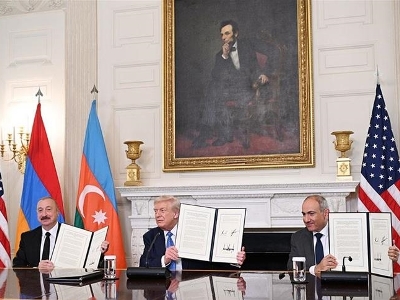
Azerbaijani President Ilham Aliyev and Armenian Prime Minister Nikol Pashinyan were back in Washington last week; just days after US Vice President JD Vance visited both countries. The White House has branded the effort a "Board of Peace" push aimed at consolidating momentum toward a formal settlement, RFE/RL reports.
The two leaders signed a peace agreement under US auspices on August 8, 2025, at a White House summit hosted by President Donald Trump. But nearly six months later, a central question remains: Has the political breakthrough translated into irreversible peace?
Speaking at the Hudson Institute on February 20, US Deputy Assistant Secretary of State Sonata Coulter described the August summit as "a decisive moment for the South Caucasus."
Coulter said both governments have taken "concrete steps to normalize relations, to open channels of commerce and transit, and to create the institutional foundations" aimed at making peace sustainable.
She framed the US administration's policy in economic terms. "If leaders choose peace, we will back them with the tools that translate peace into prosperity," she said, citing investment, security cooperation, and programs intended to strengthen sovereignty and economic independence.
At the center of that approach is the Trump Route for International Peace and Prosperity (TRIPP) project, which was designed, in US terms, to facilitate the movement of "people, goods, energy, and ideas" across the region and reduce incentives for renewed conflict.
Even as Washington emphasizes economic integration, analysts say domestic politics—particularly in Armenia—will shape the trajectory of the peace process.
Andrew D'Anieri of the Atlantic Council's Eurasia Center told RFE/RL that Coulter's mention of the TRIPP Enterprise Fund was notable, describing it as potentially "the more immediately usable pot of money" to help kick-start construction linked to the corridor.
But he pointed to Armenia's upcoming parliamentary elections as the most immediate variable.
"The biggest current question mark is the Armenian election," he said, noting that Pashinyan's party must secure another mandate to remain in power.
D'Anieri added that many observers expect Russia to attempt to influence the vote, arguing that Moscow has been critical of what he described as Pashinyan's efforts to pursue a pragmatic peace course.
"We'll know much more about prospects for peace after the June election," he said.
Richard Kauzlarich, a former US ambassador to Azerbaijan, said the relationship between the Armenian and Azerbaijani leaderships appears to have stabilized at a political level.
However, he noted this has not yet resulted in a finalized peace treaty.
At the same time, Kauzlarich warned that broader geopolitical tensions could complicate progress. With US-Iran relations strained, he said, Tehran may seek to counter what it views as expanding American influence in the South Caucasus, particularly around the TRIPP initiative.
He also cited what he described as growing rhetorical opposition from Moscow to US activity in both Armenia and Azerbaijan, including reported Russian concerns over US-Armenia nuclear cooperation.
"I don't expect either Iran or Russia to accept an easy US win in the South Caucasus," Kauzlarich said.
For now, the Trump administration is seeking to anchor peace in infrastructure, trade, and security cooperation, arguing that shared economic interests can help prevent renewed conflict.
Key steps ahead include finalizing and ratifying a comprehensive peace agreement, ensuring political stability in Armenia following elections and beginning visible work on transit and connectivity projects linked to TRIPP.