make preferable
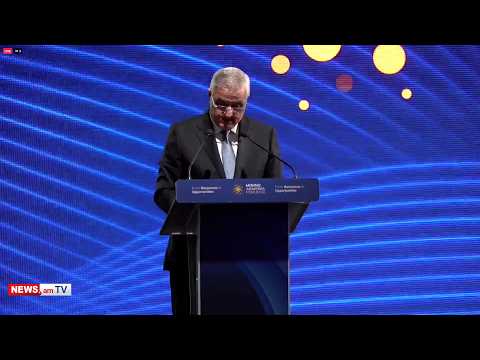
Armenia has decided on a principled approach to building a new nuclear power plant: the future nuclear power plant of the country shall be of a modular type. Territorial Administration and Infrastructure Minister Davit Khudatyan on Thursday announced this to reporters in the Armenian parliament.
According to him, at this phase, the Armenian authorities have not yet chosen the country to manufacture this modular nuclear plant, since this selection depends on the specific model of the plant. “We have made a choice of type; that is, we have decided that the new nuclear power plant in Armenia shall be of a modular type. But we have not made a selection of the manufacturing country, because the manufacturing country depends on the selection of model,” the minister noted.
Currently, Armenia is studying respective proposals from several countries at once, including the US, France, Russia, South Korea, and China. Khudatyan noted that all these countries offer different options for modular nuclear power plants. In particular, Russia also has its own model of a small modular nuclear power plant, which is currently being operated on a floating platform. However, the Armenian government does not intend to rush into a final decision.
The minister said that the operating Armenia’s Metsamor Nuclear Power Plant will be able to remain an important part of the country's energy system for many years to come. A program to extend the plant's operating life is currently being implemented, after the completion of which Armenia expects to receive a permit to operate the nuclear power plant until 2036. According to Khudatyan, after that, a new program to extend the operation is possible, so there is no urgent need to choose a new plant yet.
The minister touched also upon the capacity of the future nuclear power plant of Armenia. According to him, the widespread opinion that modular plants are significantly inferior in capacity to traditional ones does not correspond to reality. "There is no problem of capacity. We choose the capacity that we want,” Khudatyan said. He explained that the parameters of Armenia’s future nuclear plant will be determined by the needs of the country’s energy system and the financial capabilities of the state. Depending on the number of modules, the capacity can be either 100 MW or 1,000 MW. As one of the main advantages of modular nuclear power plants, the minister noted their flexibility. According to him, the development of renewable energy requires more maneuverable sources of production.
In recent years, the share of solar energy has been actively growing in Armenia. This leads to situations when at certain times of the day there is a surplus of electricity in the energy system, and the operation of traditional generating facilities is forced to be limited. According to Khudatyan, during the daytime it is sometimes necessary to temporarily disconnect the Yerevan Thermal Power Plant from the country’s energy, as well as reduce the capacity of the Metsamor Nuclear Power Plant. In the evening, when solar production decreases, these capacities are reconnected to the energy grid. That is why, according to the minister, more flexible modular reactors are better suited to the future structure of the Armenian energy sector.
The incumbent Armenian authorities hope to solve the problem of a possible electricity surplus also by increasing exports. According to Khudatyan, the construction of a new power transmission line to Georgia has already begun, and this will enable significantly increasing the capacity between the power systems of the two countries. After the completion of this project, Armenia will be able to export electricity not only to Georgia, but also—through Georgian territory—to other markets. At the same time, Armenia’s electricity exports to Iran continue. The construction of a 400 kV power transmission line is in the final phase. And after this facility is put into operation, electricity supplies may increase significantly.
Also, Khudatyan pointed to the growth of Armenia’s domestic demand for electricity. According to him, one of the growth factors has become data processing centers and servers used for the development of artificial intelligence technologies. In addition, the Armenian authorities expect further growth in industrial production and the engagement of new high-tech enterprises. The Minister of Territorial Administration and Infrastructure of Armenia noted that due to the high demand for cooling systems and ensuring the uninterrupted operation of computing systems, such facilities are among the world’s largest consumers of electricity.