make preferable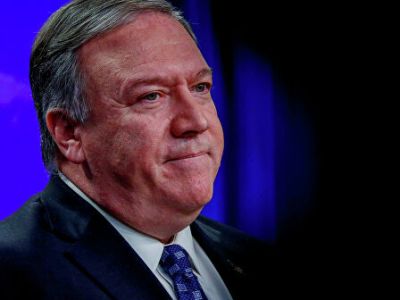
US Secretary of State Mike Pompeo has positioned himself as the most aggressive critic of China from the Trump administration, arguing that Beijing is responsible for the coronavirus pandemic, The Hill reported.
He aroused the anger of Chinese officials and state media who called him a “liar” and the common enemy of mankind” for his attacks on the Communist Party. Pompeo continues to speculate that the virus came from a Chinese laboratory, demanding a global investigation.
“We know that it originated in Wuhan, China. That much is certain,” Pompeo said.
“What we don’t know yet is precisely where it came from and how it began to spread. We can’t identify patient zero. We’ve seen evidence that it came from the lab. That may not be the case,” he added.
Some US allies - such as Australia and the EU - echoed Pompeo’s calls for an investigation into the COVID-19 spread. But they disagreed on whether such an investigation should focus on the assumption that the virus originated in a laboratory in China.
Australian intelligence agencies, which are part of the Five Eyes international intelligence sharing alliance with the US, rejected allegations that there was evidence to support the theory of a leak from the lav, saying that any information they examined was mostly taken from open sources and based on news reports.
Meanwhile, the European Union has expressed concerns that tensions between the US and China could damage the global response to coronavirus.
“I know there is a controversy [between] China and the United States about the origin of the virus,” European Union foreign policy chief Josep Borrell said in an interview with Euronews on Friday.
“We need a scientific, independent approach, not to blame, but to know,” he said.
Chinese officials have retaliated against US efforts to blame Beijing.
Trump often accused China of spreading the coronavirus, sometimes calling it the "Chinese virus." But since then, he has stoped claiming that virus escaped from a Chinese laboratory, even though he had previously said that he had seen the evidence. More recently he suggested the virus spread was a “mistake” and said it spread because of individual incompetence.
"Something happened. Either they made a terrible mistake — probably it was incompetence. Somebody was stupid, and they didn’t do the job that they should’ve done. It’s too bad," Trump said in an interaction with reporters on Thursday.
Bonnie Glaser, director of the China Power Project at the Center for Strategic and International Studies, believes that “Pompeo has been more direct, confrontational, in your face, than any other prior secretary of State we have ever had,” and the Chinese likely see his rhetoric as a threat to the ruling Communist Party.
Chinese MFA spokesperson Hua Chunying, in turn, has responded directly to Pompeo’s accusations, accusing the secretary of “fabricating lies” and “manufacturing” evidence to connect the virus with the lab.
“Where is the evidence? Show it!” she said in a briefing Thursday with reporters. “Or is he still in the process of manufacturing some?”
According to Glaser, relations between the US and China are low but have not yet bottomed out. On Thursday, US Treasury officials and their Chinese counterparts participated in a conference call and noted that “good progress” is happening on trade agreements.
However, experts argue that the two countries are more competing than cooperating, and one of the biggest risks is whether diplomatic sparring is hampering progress in developing a vaccine against COVID-19.
“It’s very much part of the great power competition that’s underway,” Glaser said. “We don’t want China to be the one to get the vaccine first.”
Thomas Joscelyn, a senior fellow with the Washington-based Foundation for Defense of Democracies notes that some of Pompeo’s criticisms of Beijing are unfounded, including reports that Chinese officials silenced informants, provided faulty statistics on the virus spread and given out inaccurate information about human transmission.
“There’s plenty of things you can hold them accountable for on that end, without pointing at this lab,” he said.
According to him, insistence on the version of the leak of the virus from the lav runs the risk of becoming worn out without clear evidence.
“If you’re going to keep talking about the lab, at some point you’re going to need to have some evidence to back that up,” he said. “If there isn’t evidence, I don’t know what they’re doing.”
“The administration’s statements on the origin of COVID-19 are far too driven by political considerations,” Sen. Chris Murphy (D-Conn.) wrote in an email to The Hill. “They are scurrying to deflect blame for a president who is foundering in his response to the pandemic, and China is a convenient scapegoat,” he added. “It’s true [Chinese] President Xi [Jinping] covered up China’s mistakes – and continues to – but the insinuation that there is clear evidence to suggest the virus was man-made is totally irresponsible.”
“He is inherently a political being,” said Scott Mulhauser, a Democratic strategist who has worked in senior foreign policy roles with former Vice President Joe Biden, the Senate Finance Committee and the U.S. Embassy in Beijing.
China has become the political flashpoint ahead of the November elections, and the number of Americans with negative views of China is growing. According to a recent survey by the Pew Research Center, Republicans are more likely than Democrats to find Beijing unfavorable.
Trump's re-election campaign ran an ad with attacks on Biden because of his stance on China.