make preferable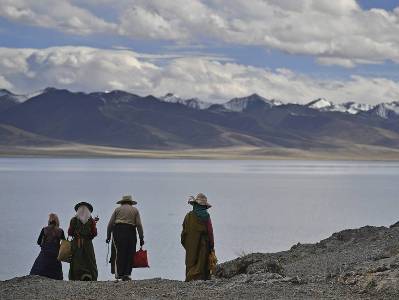
The area of lakes on the Qinghai-Tibet Plateau in China has expanded by over 10,000 square kilometers over the past 30 years according to researchers from the Chinese Academy of Sciences' Qinghai-Tibet Plateau Research Institute, reports China Daily.
The latest research by scientists from the institute's environmental change and multisphere processes team, led by researcher Zhang Guoqing, predicts that by the end of this century, the lake area will expand by another 20,000 sq km under a low-emission scenario.
That would increase water levels by an estimated 10 meters, resulting in a 652-billion-metric-ton increase in water volume—four times the increase over the past 50 years.
Zhang said that despite a global trend of decreasing large lake volumes due to climate change and human activities, the lakes on the plateau have experienced rapid expansion as the climate becomes warmer and more humid.
"This expansion has heightened the risks of lake inundation disasters and impacted ecosystems such as grasslands, wetlands and biodiversity," he added.
Xu Fenglin, one of the authors of the paper and a doctoral student at the institute, said the greatest expansion of lake area is being seen in the north of the plateau, and they could double in size under a high-emission scenario.
"The lakes in the central region of the plateau are projected to expand by over 50 percent, while lakes in the southern region, previously in a state of shrinkage, are anticipated to transition to expansion in the near future," Xu said.
"The expansion of lakes on the Qinghai-Tibet Plateau will increase lake-atmosphere exchanges, potentially leading to an increase in greenhouse gas concentrations in the atmosphere, thereby exacerbating global warming."
There are around 60,000 lakes on the plateau, covering an area of approximately 50,000 sq km. Described as the "Asian water tower," the plateau boasts the world's highest and most extensive plateau lake group, accounting for over 50 percent of China's total lake area.