make preferable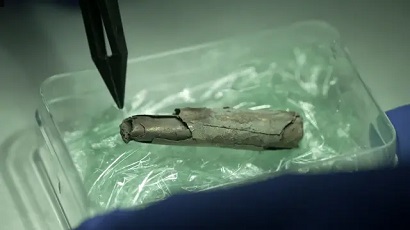
Archaeologists have unearthed what is now recognized as the oldest known Christian artifact north of the Alps, the “Frankfurt Silver Inscription,” reports Interesting Engineering.
In December 2018, during an excavation in Frankfurt’s Praunheim district, archaeologists stumbled upon a groundbreaking artifact within the remnants of a Roman-era grave. This area, once the Roman settlement of Nida, revealed a grave that encapsulated its era’s cultural and religious undertones. On December 11, the discovery was formally announced in a press release from the City of Frankfurt am Main.
The grave, dated between 230 and 270 AD, held a small but profoundly significant object. A silver amulet known as the “Frankfurt Silver Inscription.” The amulet measures about 3.5 centimeters in length and features two loops on top, suggesting it was likely worn around the neck.
Its most compelling aspect, however, was the wafer-thin silver scroll enclosed within, preserved yet extremely fragile. The scroll’s delicate condition posed a significant challenge to researchers, as any attempt to physically unroll it risked irreversible damage.
The intricate nature of the “Frankfurt Silver Inscription” required the use of advanced imaging technologies. Researchers at the Leibniz Center for Archaeology in Mainz employed a computed tomography (CT) scanner, a tool more commonly associated with medical diagnostics, to peer inside the coiled artifact, and found that the “Frankfurt Silver Inscription” contains a distinctly Christian invocation, with phrases such as “Holy! Holy! Holy! In the name of Jesus Christ, Son of God. … Protect the man who surrenders himself to the will of the Lord Jesus Christ, Son of God, since before Jesus Christ every knee bows.”
This text is significant not only for its content, but also for its language. While many early Christian artifacts featured inscriptions in Greek or Hebrew, the use of Latin in this context points to a sophisticated and potentially educated Christian community in the region.
The discovery of the amulet predates the previously known artifacts and textual references to Christianity in Northern Europe by several decades, approximately 30 to 70 years earlier than the earliest evidence dated to around 300 AD.