make preferable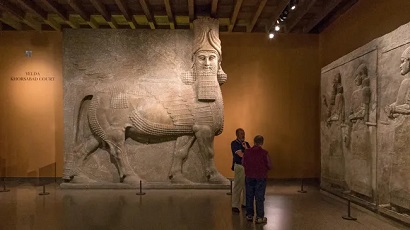
Archaeologists in northern Iraq have discovered the remains of a massive villa, royal gardens, and other structures buried deep underground at what was once the ancient Assyrian capital of Khorsabad, a new magnetic survey reveals, reports Live Science.
The international team of researchers used a magnetometer in unusually taxing conditions to detect the 2,700-year-old city's water gate, possible palace gardens and five large buildings—including a villa with 127 rooms; that is, twice the size of the White House.
The previously undiscovered structures challenge the notion that Khorsabad was never developed beyond a palace complex in the eighth century B.C., according to an American Geophysical Union (AGU) statement.
Neo-Assyrian emperor Sargon II started building his giant new capital—originally called Dur-Sharrukin, meaning "Fortress of Sargon"—in 713 B.C. But Sargon died in 705 B.C., possibly before the capital's occupancy and completion. Sargon II's son and successor, Sennacherib, then moved the capital to the city of Nineveh, and Khorsabad was abandoned and forgotten for over two millennia.
Over 25 centuries later, French and American archaeological missions in the 1800s and 1900s, respectively, unearthed Khorsabad's palace, including iconic “Lamassu” statues of winged bulls with human heads that are now at the Louvre.
Beyond the palace and the city's 1.1-by-1.1 mile (1.7-by-1.7 kilometers) walls, however, the layout of the ancient capital remained a mystery, and archaeologists assumed it had been left unfinished. In 2015, Khorsabad was looted by the Islamic State, and archaeologists were able to resume work at the site only when the militant Islamist group largely withdrew from the region in 2017.