make preferable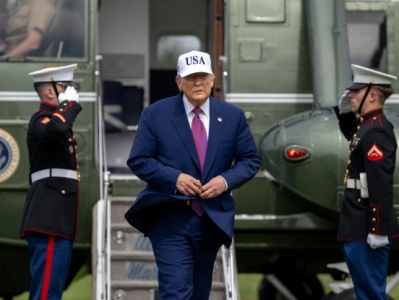
For several weeks, Donald Trump had been assembling an armada of aircraft carriers and destroyers in Middle Eastern waters, backed by squadrons of F-35 and F-22 fighters deployed to allied bases in the region. It was the largest concentration of US forces since the 2003 Iraq War that toppled Saddam Hussein, Bloomberg writes.
Trump's goal was to force Iran's rulers to do what they had resisted for decades: abandon their nuclear program and long-range ballistic missiles, and cease support for armed proxies. He had stated he would prefer a diplomatic solution with Tehran, but military preparations continued.
Meanwhile, as his negotiators — son-in-law Jared Kushner and Steve Witkoff — prepared to fly to Geneva for further discussions, the calculus was gradually shifting toward conflict.
By Thursday, the Geneva talks had produced no breakthrough. Despite this, some uncertainty remained, and the parties agreed to return later for another meeting after consulting with Ukrainian and Russian officials.
Iranian officials believed the second round of talks showed progress. But by the end of the day, Kushner and Witkoff had concluded that all avenues were exhausted. In their view, Supreme Leader Ayatollah Ali Khamenei's worldview left little room for coexistence with Trump's vision for the Middle East.
After 16 hours in Geneva, the Americans flew back to Washington, holding to their own deadline. Although plans for new talks the following week had been announced, Omani Foreign Minister Badr Al-Busaidi — the mediator in the Geneva negotiations — was alarmed and became convinced that conflict was inevitable. On Friday morning he flew directly from Geneva to Washington to meet with Vice President J.D. Vance, a long-time skeptic of foreign intervention who could still influence the president on Iran.
The initiative angered some of Trump's hawkish advisers, some of whom characterized it as near-treachery — a foreign power attempting to sway the president's inner circle at a critical moment.
That same day at the White House, Trump was preparing to fly to Texas for domestic political events, ahead of an important primary vote. His mood on Iran was souring.
Officials briefing him reported that while a short-term deal with Iran seemed possible, it would not resolve key issues such as the missile program. At a Texas rally, Trump said he was "not happy" with the progress of negotiations.
Trump left Texas and flew to Florida, to his Mar-a-Lago resort, while Vance gathered Cabinet members in Washington. That same night, Rubio notified some US lawmakers of a likely military action against Iran.
In a video recorded without press present and released overnight, Trump announced the attack and called on the Iranian people to overthrow the ruling regime, accusing it of "mass terror."
"No president has been willing to do what I am willing to do tonight," he said in the video. The war had begun.
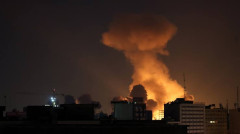
Explosions swept across Iran. In response to hundreds of joint US-Israeli strikes, Tehran launched volleys of missiles at US and Israeli targets across the region.
Air defense systems fired over Riyadh, Doha, and Abu Dhabi, where residents reported explosions and falling debris. In Bahrain, home to the US Navy's Fifth Fleet, a US-linked base came under fire. In Abu Dhabi, one person was killed by debris from an interception.
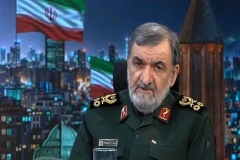
As with the US invasion of Iraq in 2003, the first hours of the conflict proved decisive: Trump and Israeli Prime Minister Benjamin Netanyahu announced Khamenei's death. Iran later confirmed it. Other senior leaders were also reported killed, including the defense minister and the head of the Islamic Revolutionary Guard Corps.
Nevertheless, as the US painfully learned in Iraq and Afghanistan, the first hours rarely determine the entire conflict.
Trump, at least for now, is relying on air power while attempting to mobilize Iranian citizens — where no organized opposition exists — to do the ground work he is avoiding.
In a social media post, Trump promised to continue "heavy and pinpoint bombings" nonstop "for a week or as long as it takes." He also urged Iranians to seize the opportunity being given to them.
For Trump, this is already his second major military action against an adversary since the start of the year. Emboldened by the swift and successful toppling of Venezuela's leader, Trump once again broke with standard MAGA strategy and chose to launch a selective war. A leader who a decade ago railed against US "forever wars" has taken the greatest risk of his tenure, the consequences of which may be felt for years.
But the president appears unconcerned. White House Press Secretary Karoline Leavitt stated that Trump is sticking to his previously planned weekend schedule.
"President Trump still plans to attend the fundraiser being held tonight at Mar-a-Lago for the Republican Party, which is now more important than ever," she said.