make preferable
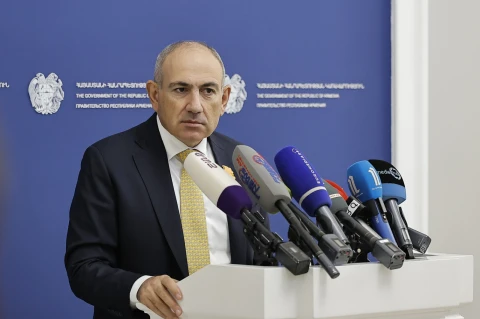
I think that complementarity is a catastrophic mistake for Armenia. And this mistake is not new, this mistake is not even 30 years old, this mistake is not even 100 years old, this mistake is much older, Armenian Prime Minister Nikol Pashinyan said in an interview with Agence France-Presse, when asked whether the Ukrainian war had impact on Armenia's foreign policy.
“I am not criticizing the past governments and I am not criticizing anyone, because look, your question is about how Armenia is going to live between Russia and the West. But in reality we are not between Russia and the West, we are actually between Georgia, Turkey, Iran and Azerbaijan. And in reality, the countries of the region are among one another.
In our 2020 election program, the program of our government there is a clause which is called regionalization. I say again, experience and our history shows that this is not about 10, 20, 30 or even 40 years, this is about centuries. We are living here, we are not living between Russia and the US, it’s Europe that lives between Russia and the US. We live between Georgia, Iran, Turkey and Azerbaijan. And the question is the following – should we manage our relations with our neighbors, I am sorry to use that word, through Moscow, Washington and Brussels. In terms of the paradigm - no, but in practical terms we lack that political tradition.
Deep down, that’s the cause of our whole problem, because what we should me also concerns me, because there are many historical, social-psychological layers here, and this issue cannot be resolved on the level of an individual having power and mandate. It’s not so that I have ridded me of this problem. Any person sitting here in this position in the last few hundred years, possible even longer, would have this problem, I am speaking about Armenian statehood.
If we have a problem or an issue with our environment, our first reaction is to check what Moscow, Brussels or Washington can do. Of course, during this period the capitals, their names might have changed over this long historical run. And we comprehend this. But nothing has changed in our life, because we also lack that culture, they also lacked it. And we lack that because of a certain historical tradition, and they lacked it because of a certain historical tradition.
When the time comes , and there is a chance, an opportunity, or maybe a realization that another paradigm should be applied for solving the issues, a different logic emerges in our environment – well, you have come to resolve issues with us, wasn’t that you that brough Washington, Moscow or Brussels on us for a long time? Ok, come over here now. You asked me about the paradigm, our paradigm is not between Moscow and Washington.
But on the other hand, in the 21st century, or even in the 19th century, it was not possible to pursue a policy bypassing the geopolitical centers, and that’s no needed and not even reasonable. The challenge here is that we are trying to change the name, saying a balanced and balancing policy is what we need. We do not want this new paradigm, which is so far still a theory, I tell this directly, we realize this, but we are still unable to implement it. And that’s because of us, because it’s one thing when you know what you need to do, and it’s another thing that the tradition is not that.
But on the other hand, this policy should not be perceived as a policy of bypassing or ignoring the geopolitical centers, but we are also trying to take steps. When I went to participate in the inauguration of the Turkish president, there were both positive and negative reactions in Armenia. These reactions reflect this whole tangle. And the challenge is when we speak about paradigm, to what extent are we going to be in the mode of cooperation, rather than in the mode of monologue, because this is not easy for anyone to perceive and realize that in this region for example, this political map should continue to exists for centuries to come. Some people put a question mark after this sentence. Some people frankly want to find justifications so that this political map can stem from the interest of all the regional countries without contradicting the interests of geopolitical centers. I, for example, bear this second belief, but that’s not enough,” he noted.