make preferable
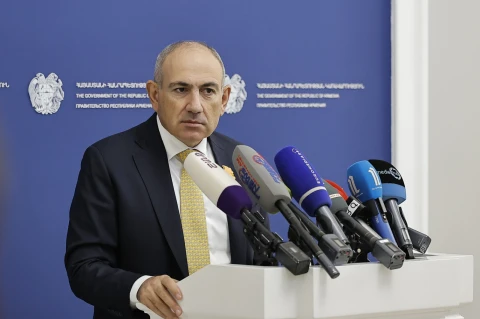
They are attempting to present the Washington documents within the framework of the “Crossroads of Peace” concept — as if they are its continuation or a practical step in that direction, said Robert Kocharyan, the second President of Armenia, during his press conference Tuesday.
“Each country’s transit potential consists of three components: first is the country’s geopolitical position, second is the terrain, the third is the condition of the road networks — [their] quality, development, and so on. The first two conditions are mandatory. If those conditions are there, then the third — the state of the roads — is simply a matter of investment, work.
Now, I suggest we look at the map and understand what the ‘Crossroads of Peace’ [project off the Armenian government] actually means and what transit potential Armenia has.
Turkey and Georgia have every opportunity to communicate with each other while bypassing Armenia. The same goes for Turkey and Russia — there are many more Turkish vehicles passing through [the] Upper Lars [checkpoint on the Russian-Georgian border] than Armenian ones. In the case of Georgia and Azerbaijan as well they are fully connected through existing transport links, and the main active corridor working between the Caspian and Black Seas is precisely this one. Iran and Azerbaijan also have every possibility to connect, and Iran–Azerbaijan trade does not go through Armenia’s territory. The same is true for Turkey and Georgia — it’s simply pointless. No trucker would attempt to go to Georgia through Armenia. The situation is the same in the case of Iran–Turkey, too.
Essentially, due to its geographical location, Armenia has almost no transit potential for these countries, but there is one exception — Azerbaijan-Turkey. In Azerbaijan–Turkey relations, the proposed corridor is indeed of significant importance, and it has several components. As a Turkish project, it genuinely has transit potential. Another important factor: each transport corridor is also geopolitical influence, factor for that country through which it passes. Only the part of Armenia’s territory that has transit potential is being given to the US for long-term management under a contract. It is only that part of Armenia — the part with transit potential as well as geopolitical weight — that is being transferred,” said the second president of Armenia.
Addressing the question of what Armenia can expect from the Trump Route for International Peace and Prosperity (TRIPP) regional communication project, Kocharyan said: “First, if the Yeraskh–Julfa–Iran railway starts operating, we [i.e. Armenia] will obtain a railway connection with Iran. And if we get a railway connection through Azerbaijani territory. These are the only two factors of interest for Armenia. If Armenia does not get these two things, the entire project is meaningless and dangerous for Armenia.
It has been announced that the Kars–Igdir–Nakhichevan railway is under construction. This means that railway traffic along this corridor can operate without hindrance, but the connection with Armenia might not work at all. As a result, we will gain nothing in terms of connectivity with Iran and Russia. If such a risk becomes reality, can we somehow force the US, which will be managing the Trump road, to act differently? I highly doubt it.”