make preferable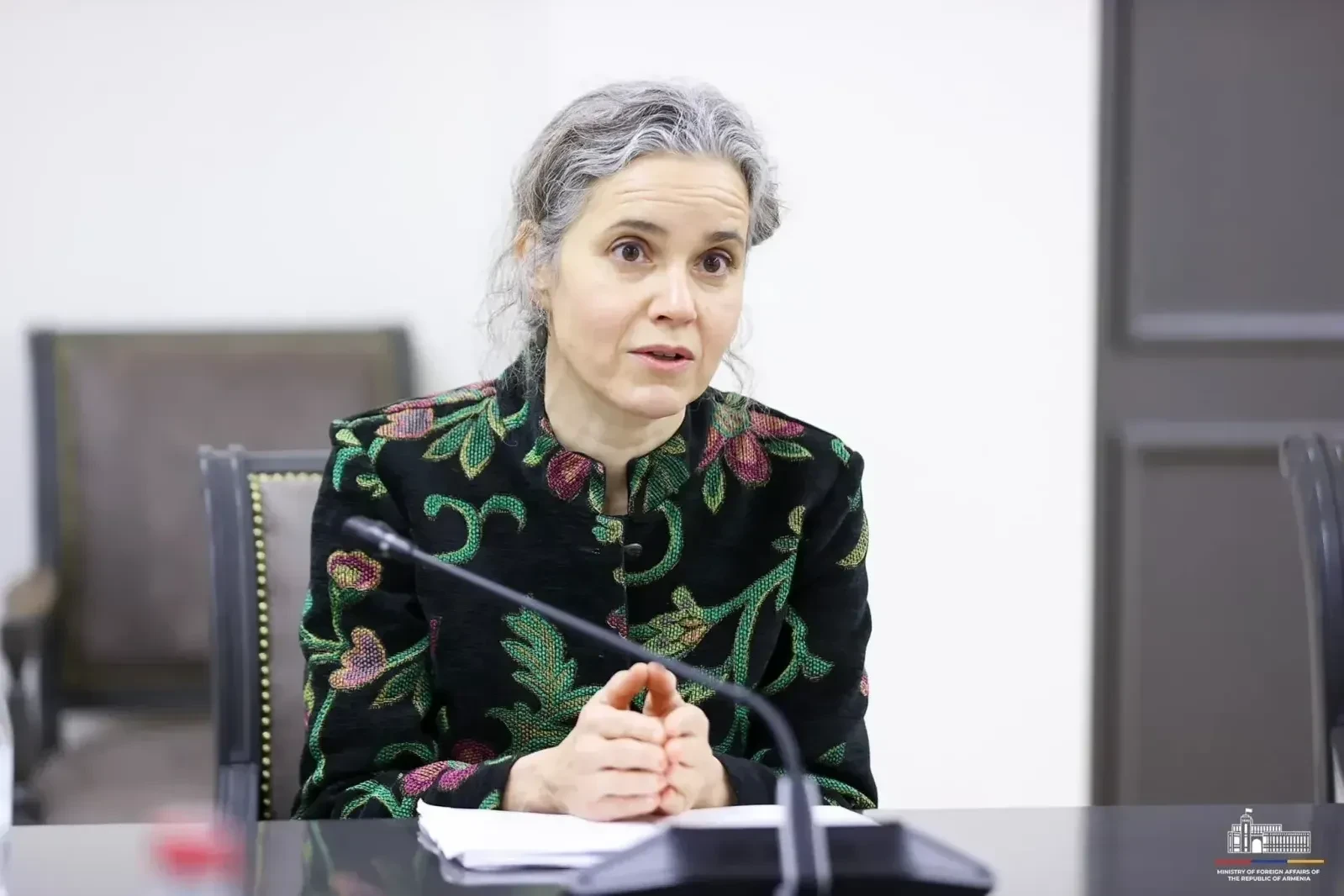
YEREVAN - In an exclusive interview with NEWS.am, European Union Special Representative for the South Caucasus Magdalena Grono defended her participation in a recent Baku-hosted diplomatic tour of Nagorno-Karabakh, pushing back against criticism that the visit legitimizes the 2023 ethnic cleansing and forced displacement of more than 100,000 Armenians or turns a blind eye to the ongoing destruction of Armenian cultural and religious heritage.
Ms. Grono, you were among the foreign diplomats who took part in the visit to Nagorno-Karabakh organized by the Administration of the President of Azerbaijan. The visit raised serious questions about Baku’s commitment to genuine and lasting peace, particularly in light of statements by Hikmet Hajiyev portraying Armenian medieval churches as Albanian. Such claims hardly contribute to mutual trust or the establishment of lasting peace. Why did you decide to participate in this visit?
Indeed, I participated in a visit in Azerbaijan to the Karabakh and adjacent regions on 11-12 September 2026. This was the 22nd such visit conducted by the Azerbaijani authorities for members of the diplomatic community over the past few years, with the aim to familiarise them with ongoing demining, reconstruction and resettlement efforts. As has been the case on previous occasions, it was widely covered by Azerbaijani media outlets and journalists present with us on the ground, publishing updates, photos and videos almost in real time. This two-day trip also included visits to several sites of cultural heritage, including mosques and churches, and allowed for a series of informal meetings and events in the margins, also with former IDPs.
For me and my colleagues, the visit represented an important opportunity to see developments on the ground firsthand. During my numerous interactions with officials but also local journalists in the margins of the visit, I reiterated EU's strong political commitment to support the Armenia-Azerbaijan bilateral peace process in all its dimensions, in an impartial way. On this occasion, I also underlined the need to work further towards societal reconciliation, including on issues of cultural and historical heritage.
I know how sensitive these issues are and I am obviously well aware of the negative comments and criticism expressed in Armenia over the past few days regarding the participation of members of the diplomatic community in this visit. To be very clear: in no way would I deny or contest past Armenian presence and rich footprint in the area. Also, states have an obligation to preserve and protect all places of cultural and religious heritage. In the South Caucasus, this heritage should be cherished and transmitted to future generations, without any politicisation and manipulation.
During more than 25 years of working in the South Caucasus region as well as over the past few days, I again witnessed many beautiful examples of the rich and historic Armenian cultural heritage. For me, this visit was an opportunity to see with my own eyes the current situation on the ground, including in Kalbajar and Aghdara districts. The visit also demonstrated that on the particular issue of cultural heritage, there does not seem to be an agreement between Armenia and Azerbaijan when it comes to the historical facts.
The visit took place amid extensive evidence and reports of the destruction of Armenian churches, cemeteries, and other cultural heritage sites by Azerbaijani authorities. Doesn’t the participation of foreign diplomats in such visits give Baku an opportunity to continue its systematic destruction of Armenian cultural heritage in Nagorno-Karabakh without any restraint?
There have been multiple reports referring to destruction in former conflict-affected areas over the past few years, but also during earlier stages of the conflict and indeed since the early 1990s, attributed to both sides. Such reports need to be independently verified by cultural heritage experts. The repeated failed attempts to organise international cultural heritage fact-finding missions to the affected areas, due to disagreements between the sides, before and after the 2020 war for instance, are a testament to the challenges of independent verification.
The visit last week also allowed us to get a better understanding of where things stand at the moment, be it in terms of reconstruction of historical mosques and the state of churches and monasteries. It also allowed for on-site exchanges with Azerbaijani officials, including on certain narratives that are deeply divisive. Our work as diplomats is to engage as much as possible with different interlocutors, to listen and to discuss with each other as appropriate.
Could such visits be perceived as justifying or legitimizing the ethnic cleansing that took place in Nagorno-Karabakh in 2023 and resulted in the forced displacement of more than 100,000 Armenians? What is your assessment of this as a senior EU official, particularly given the EU’s previous role as a mediator in the Armenia-Azerbaijan negotiations over Nagorno-Karabakh and the EU’s stated commitment to protecting human rights?
In no way can the EU be perceived as justifying or legitimising use of force and past violence. The EU has always had a very clear and consistent position on past developments, as also expressed in the “statement by the High Representative on developments in Nagorno-Karabakh” on 21 September 2023.
Since then, Armenia and Azerbaijan made the historic choice to engage into a bilateral peace process, which has opened a new era for the South Caucasus and already brought lots of benefits to the sides. The EU is strongly supportive of these efforts, including the series of positive developments that we have been witnessing since the Washington Peace Summit in August 2025, such as stability along their bilateral borders, the continuation of border delimitation and demarcation talks, the launch of bilateral trade and the conduct of dialogue between civil society representatives under the “Peace Bridge” initiative.
Significant challenges remain, not in the least when it comes to dealing with past traumas and suffering and the cases of missing persons, among others. For peace to be genuinely irreversible, legacies of past conflict will need to be addressed by the sides. It is our strong hope that Yerevan and Baku will address these challenges in the framework of their broader reconciliation efforts at the right time. For its part, the EU will continue to support the bilateral peace process as much as possible.
Hayk Sahakyan