Preferred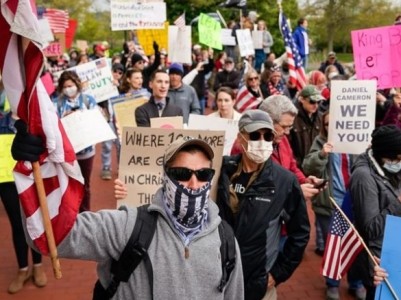
Last weekend, Texas, Indiana, New Hampshire, Nevada, Maryland, Utah and Wisconsin held protests against quarantine imposed amid the coronavirus pandemic, reflecting increasing tensions over state government responses, Vox reported.
Protests followed other similar events last week in Florida, North Carolina, Virginia, Michigan, Minnesota, Idaho, Kentucky, and California. During the protests, demonstrators walked in close contact with each other with banners in their hands criticizing the governors and demanding to go back to work.
At an Austin rally, protesters greeted Alex Jones, the founder of right-wing conspiracy theory website Infowars, as he drove by shouting, “Everybody knows we’ve been attacked by biological weapons” on a megaphone.
With the exception of conspiracy theories, most protesters were annoyed by the lack of work. The stay-at-home directive led to the closure of many companies resulting in economic distress for millions of Americans.
According to a recent US Department of Labor report, over 22 million Americans — about 14 percent of the US workforce — have applied for jobless claims since mid-March, when most restrictions for states across the country began. While Congress approved supplementary unemployment benefits, many new unemployed Americans struggled to gain access to these benefits, which was complicated by bureaucratic delays.
President Donald Trump has promised a quick economic recovery and announced his administration’s intention to open a business in the US, although the decision will ultimately be left up to the states. Multiple states began easing some restrictions on Friday opening beaches, parks, and golf courses, and earlier this week several governors on the East and West Coasts and the Midwest announced regional agreements with an economic recovery plan. But despite protests in recent days and federal pressure, it seems that most Americans are not yet ready to return to normal life.
Although the demonstrators may have made a lot of noise this weekend, polls show that they are outnumbered.
Between April 7 and 12, the Pew Research Center interviewed nearly 5,000 people, 66 percent of whom said they were worried that social distancing would end too soon.
A Gallup poll conducted between April 10 and 12 showed that Americans are more worried about getting COVID-19 than are worried serious financial difficulties due to restrictions.