make preferable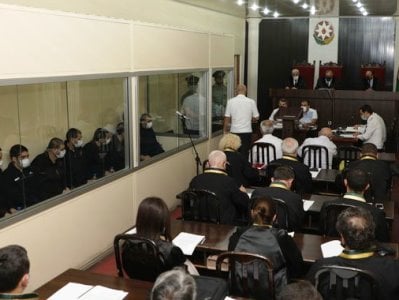
The “trial” of Armenian captives in the Azerbaijani capital Baku is taking on new shades. The organizers of this disturbing performance use it to give "credibility" to the mind games and slander which are aimed to make more terrible among the Azerbaijani people the image of the enemy—the Armenians.
This time the trial and judgment was used in order to "confirm" the "Armenian trace" in the July 3, 1994 explosion in the Baku subway. Accordingly, Zahid Hasanov, a “victim” in the criminal case against Armenian captives Lyudvig Mkrtchyan and Alyosha Khosrovyan, "testified" that Azer Aslanov, the person who blew up the subway, had been arrested with him, and that they were in captivity together in Stepanakert, the capital of Nagorno-Karabakh (Artsakh).
"Me, Sergei, Azer Aslanov, and another hostage were kept in Khankendi [(i.e., Stepanakert)] as a hostage. 5-6 Armenian militants came, took Azer Aslanov to clean the commander’s room. Azer returned after 2 hours, then they took him again. Special service bodies of Armenia conducted a special talk with Azer. Azer was instructed in room of Samvel Babayan. One of those, who instructed Azer, was Ludvik Mkrtichyan. They talked for more than an hour. Sergei came and said that Azer did not clean the room. It was found out that they took Azer Aslanov and did not make him clean the room. After the incident, they gave Azer every meal, which he wanted. It was found out that Azer Aslanov cooperated with Armenians. In that year, Azer Aslanov exploded the metro in Baku. After returning from captivity, I heard that Sergei was shot in hostage," Hasanov said, APA reports.
The terrorist attacks—on March 19, 1994 and July 3, 1994—at the Baku subway were being used by the Azerbaijani authorities to put pressure on the Lezgin community of Azerbaijan, "finding" a link between the "organizers" of the two explosions and the Armenian special services. In particular, since those found guilty in organizing and carrying out the two bombings were Lezgins, Baku began to exert pressure on national minorities in Azerbaijan, and some link was "found" with the Sadval separatist movement of the Lezgins.
The trend in Azerbaijan to link national movements to "inimical Armenia" is quite logical and understandable; they were used as a lever of pressure on people who were inconvenient for them. And as a result of these repressions, 30 "accomplices" were convicted, several dozen Lezgin activists were imprisoned, and five people died behind bars.