make preferable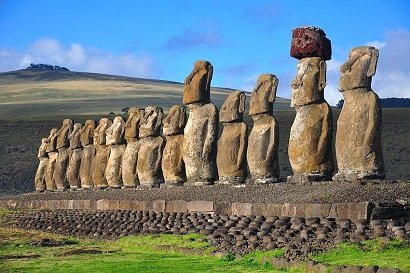
A new study sheds light on one of archaeology’s most mysterious questions: how the ancient inhabitants of Easter Island (Rapa Nui) moved their legendary stone moai statues.
The findings were published in the Journal of Archaeological Science.
Researchers from the Czech Technical University in Prague concluded that the massive statues—over 4 meters tall and weighing up to 90 tons—could have been moved upright, rocking like a pendulum, with the help of just 15–60 people.
Previously, it was believed that the statues were transported on logs, rollers, or earthen pathways, a method that would have required enormous resources and widespread deforestation, contradicting archaeological evidence. The new modeling shows that the secret lay in the statues’ very design. Their slightly forward-leaning bodies and low center of gravity created ideal conditions for a pendulum-like movement.
The scientists digitally recreated over 60 models of statues positioned along the ancient “moai roads.” Computer simulations showed that if three ropes were tied around a statue and pulled in a coordinated manner from different directions, the statue could “walk” forward like a living giant. This movement resembled the rocking motion of a refrigerator or cabinet when nudged: the statue would sway and advance in small steps.
According to calculations, a team of 15–60 people could move a statue about 300 meters per hour, while 5–25 people were enough to maintain its balance.
Thus, a 10-kilometer route from quarry to installation site could have been completed in roughly 30–40 hours of work.
Study leader Josef Dvořák noted: “Our data show that the ancient Rapa Nui masters had an excellent understanding of balance and pendulum physics. They relied not on brute force, but on intelligence and coordinated effort.”