make preferable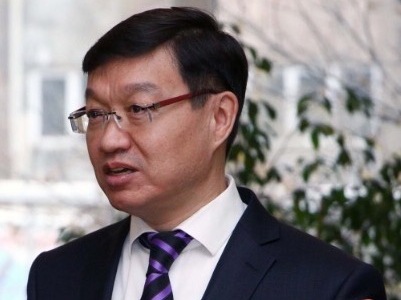
Kazakhstan puts the Nagorno-Karabakh issue outside the scope of the tasks, which are decided pursuant to the Collective Security Treaty Organization (CSTO) Charter. In an interview with Armenian News – NEWS.am, the Ambassador of Kazakhstan to Armenia, Timur Urazaev, expressed satisfaction with the level of political cooperation between Yerevan and Astana, pointing the objective difficulties and ways of developing the bilateral trade relations.
How would you describe the political cooperation between Armenia and Kazakhstan during 2016?
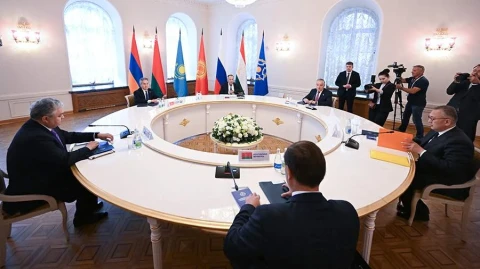
The bilateral relations between Kazakhstan and Armenia—first of all, at the political level—are assessed as very constructive, very useful and mutually beneficial. This is the real assessment of what we have achieved over the past 25 years of modern history. The key index of the intensive relations is the participation of both Kazakhstan and Armenia in very close formats of cooperation in the Eurasian Economic Union and the Collective Security Treaty Organization. If we had certain issues in our bilateral relations, we would not be able to participate in these organizations.
As to the bilateral ties per se, Armenia constantly supports us in international initiatives—as well as our candidacy in the UN Security Council—when holding EXPO and in many international issues. We also support our Armenian colleagues during voting in many international platforms.

Both Kazakhstan and Armenia have their form of partnership with NATO. Kazakhstan and Armenia also actively cooperate with the EU. Our positions on the big international agenda are quite close. I see no problems there.
As to the trade relations, there is unfortunately a great unused potential here, even given the quite objectively existing difficulties, which are first of all of transportation and logistical nature. Both the Kazakh and Armenian colleagues keep this topic among the priority issues. The turnover of goods between our countries is quite low: as to the results of last year, it constituted only $5.5 million. And most of this turnover is covered by the export of Armenian products through the efforts of the businessmen, who are, as a rule, our citizens of Armenian nationality. From the perspective of small and medium-sized business, we do not yet have an opportunity to compete with the Russian exporters.
I don’t think that the investment conditions in Armenia are worse than in Georgia. I think the investment opportunities may even be better [here]. The wonderful GSP+ trade regime between Armenia and the European Union is used, which gives a unique opportunity not only for Kazakh but also any international partners of Armenia to invest in the territory of the country very successfully.
During January-October of the year 2016, the turnover of goods between Armenia and Kazakhstan already grew by 55.4 percent. I think the finding of new nomenclature of goods, which should be in demand, can first of all serve as a point of trade growth between Kazakhstan and Armenia
The export of Armenian goods—wine and brandy production and jewelry—covers 98 percent of turnover of goods between Kazakhstan and Armenia, whereas the Kazakhstan export in January-February of the year 2016 constituted only nearly $294,000. How can we improve the situation? We should first of all think of improving the capacities of the northern route from Armenia to the territory of Kazakhstan via Georgia and Russia, considering the seasonality of Upper Lars. Parallel with this it is also necessary to develop the southern route to Kazakhstan via the territory of Iran and Turkmenistan.
How would you describe the effectiveness of the CSTO activity, considering the dissatisfaction repeatedly expressed by the Armenian President in regard to the position of the organization’s member-states concerning the violation of the ceasefire regime by Azerbaijan on the border with Armenia?
First of all, the CSTO Charter puts in black and white that the member-states shall provide necessary assistance to each other in repelling the external aggression from a third state, which is not included in this organization. The problems on the border between Armenia and Azerbaijan have not so much to do with Armenia but with the issue round Nagorno-Karabakh. Part of the border in [Armenia’s] Tavush province is adjacent to the regions, which are under the control of Armenia. In Kazakhstan, Russia and other CSTO states we initially had a precise and open position: it is one thing if the issue concerns the external aggression of a third state regardless of any territorial issues, but it is quite another thing if that relates to Nagorno-Karabakh. Thus, the position of Kazakhstan is honest: We put the Karabakh issue outside the scope of the tasks, which are decided pursuant to the CSTO Charter. We are only for the peaceful resolution of the Karabakh issue, being absolutely against its military settlement.
Could you please also tell how the New Year is celebrated in Kazakhstan? What traditional dishes are served on that day?
Any New Year is first of all a family holiday for us: it unites all of us round the “dastarkhan.” In the Kazakh language, “dastarkhan” means “laid table”: it literally means tablecloth, suggesting a festive table. Apparently, traditional dishes are cooked. “Yet” («Йет»), which is translated as “meat” is considered a traditional dish in our country. In colloquial speech we also call it “beshbarmak” («бешбармак»).
What would you wish to Armenia and the Armenian people?
I would like to wish abundant tables to be laid not only on festive days but also after the New Year. On this occasion we say “Dastarkhan mol bolsin” (“Let the dastarkhan be rich”). I first of all wish Armenia peaceful situation on the border, which would be absolutely devoid of any tint. It is necessary to hope for the neighbors’ ability to find mutual understanding and listen to each other. I see the readiness of the Armenian political leadership to reach agreements, but I would like to hear this from Armenia’s neighbors as well.